Need Assitance?
Call us at 844-203-6588.
We Accept

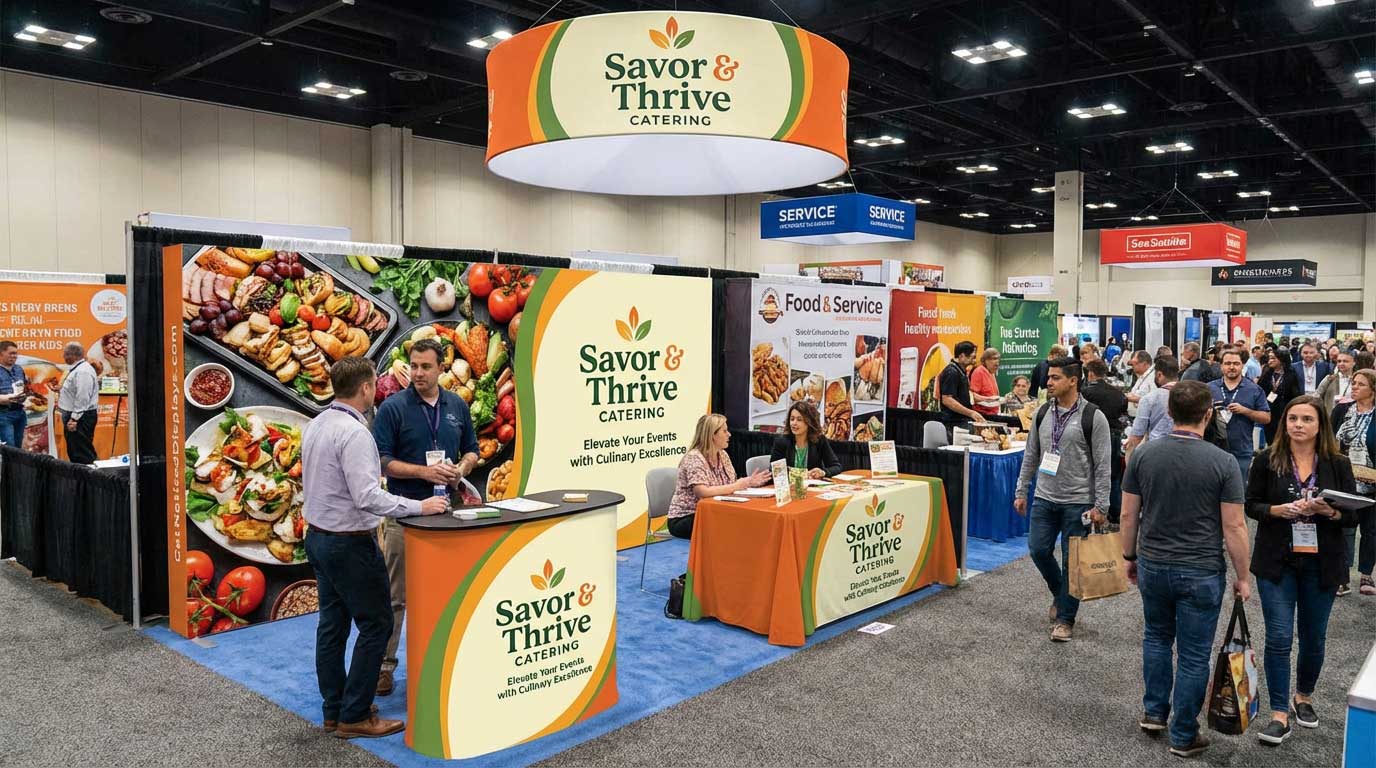
When you walk a trade show floor, one display format dominates the landscape more than any other: the fabric pop up display. These versatile, lightweight backwall systems have become the go-to solution for exhibitors who want maximum visual impact with minimal setup hassle. Whether you’re a first-time exhibitor or a seasoned trade show veteran looking to refresh your booth, understanding the full range of fabric pop up options will help you make a smarter investment.
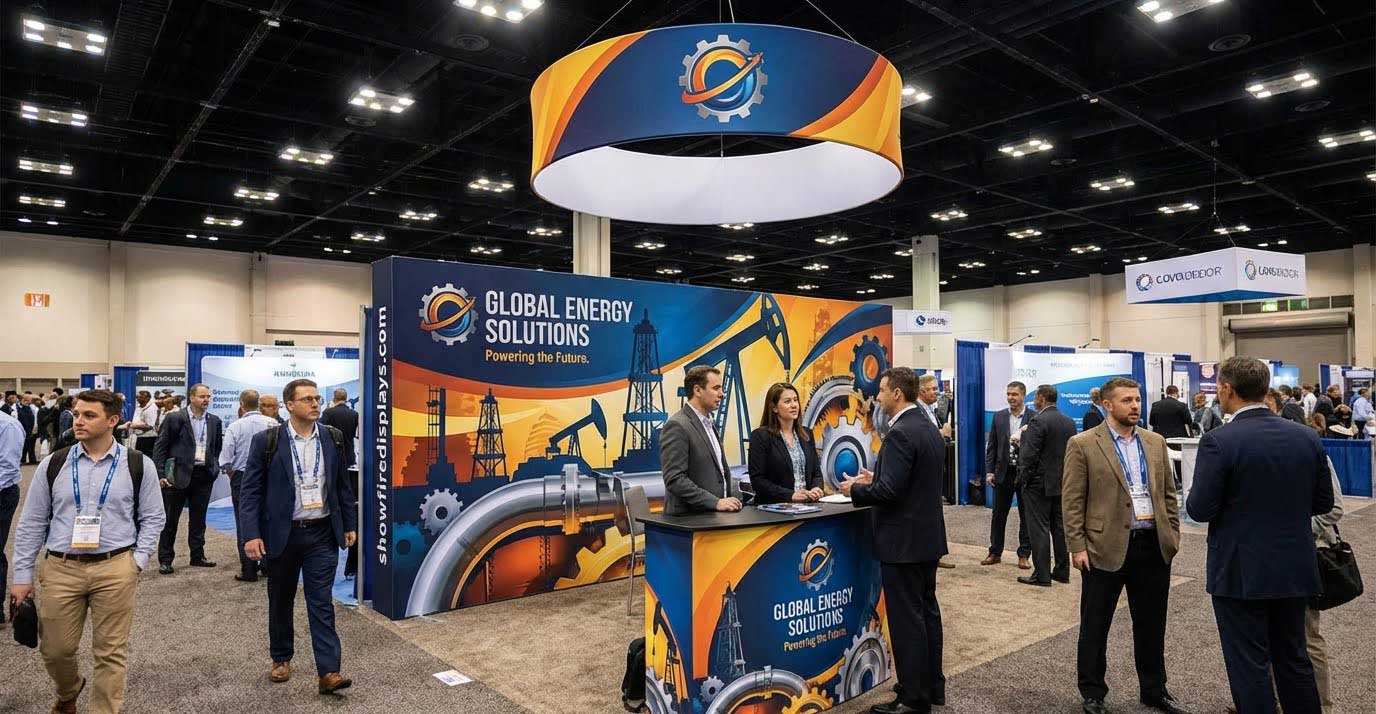
A fabric pop up display is a portable backwall system that combines a collapsible aluminum frame with a custom-printed fabric graphic. The graphic typically stretches over the frame using either a pillow-case style slip-on design or a hook-and-loop attachment, creating a seamless, wrinkle-resistant presentation wall. Unlike older vinyl or panel-based systems, today’s tension fabric displays deliver vibrant, dye-sublimation printed graphics that look sharp from any angle and any distance.
These displays serve a wide range of purposes — from trade show backdrops and retail environments to corporate lobbies, press conferences, and event photo walls. Their appeal is simple: they’re easy to transport, fast to assemble, and they deliver a polished, professional look that elevates your brand without breaking the budget.
If you’re exploring all your options for exhibit hardware, our complete trade show displays buyer’s guide is a great starting point that covers every major display category side by side. But if you already know that a fabric pop up is right for you, keep reading. When you are ready to compare kits, the Showfire pop up display collection is organized by width: 5ft fabric pop up display, 8ft fabric pop up display, 10ft fabric pop up display, 15ft fabric pop up display, 20ft fabric pop up display and 30ft fabric pop up display, each sold as a complete graphic package with or without endcaps. This fabric pop up display buying guide covers every type, size and configuration, shows you how to choose a pop up display for your booth, compares fabric with vinyl and other display types, and points you to our in-depth guides on setup, sizing and graphics.
Before diving into types and sizes, it’s worth understanding why fabric pop up displays have overtaken older display technologies to become the industry standard for portable backwall systems.
A complete custom printed fabric display — frame, graphic, and hardware — typically packs into one or two carry bags or a wheeled shipping case. Most 10ft display systems weigh under 30 pounds fully loaded, making them easy to check as airline luggage or ship via ground freight without incurring the heavy drayage fees that come with larger exhibit systems.
Most fabric pop up systems can be assembled in under 15 minutes by a single person. The frames either pop open accordion-style or connect with simple push-button connectors. The fabric graphic then slips over the frame like a fitted sheet or attaches with integrated zipper channels. No tools, no loose hardware, no frustration.
Modern dye-sublimation printing infuses ink directly into the polyester fabric, producing rich, photo-quality graphics that won’t crack, peel, or fade the way older vinyl graphics did. The matte finish of fabric also eliminates the glare problems common with vinyl and rigid panel displays, which means your backdrop display looks great under any lighting — including harsh overhead convention center lights.
Because the fabric graphic is a separate component from the frame, you can update your messaging or branding by simply ordering a new graphic — no need to replace the entire system. This makes fabric pop ups one of the most cost-effective long-term investments in the display world.
Tension fabric displays stretch tightly over their frames, which means minor wrinkles from shipping typically disappear once the graphic is installed. For stubborn creases, a quick pass with a handheld steamer does the trick. Compare this to vinyl banners that hold every fold line permanently.

Not all fabric pop up displays are built the same way. Understanding the different construction types will help you choose the right system for your specific needs, budget, and setup preferences.
If you are still weighing all the types of pop up displays, including the older hard-frame panel systems, fabric has largely replaced them on the show floor. Our comparison of tension fabric vs pop up frame displays walks through the five differences that matter before you buy.
The classic pop up display uses an expandable frame — a lattice-like aluminum structure that collapses flat for transport and expands outward by pulling the frame apart, much like an accordion or a baby gate. These frames are extremely popular because they set up in seconds. You simply pull the frame open, lock it in place, and attach the fabric graphic.
Accordion-style frames are available in both straight and curved configurations. Curved versions create a gentle arc that wraps around your booth space, adding depth and dimension to your presentation. Straight versions produce a clean, flat fabric display wall that works well when you need to tile multiple units together or position the display flush against a wall.
Push-fit displays use a series of lightweight aluminum tubes that connect together using push-button connectors — similar to tent poles. Once the tube frame is assembled, a pillowcase-style fabric graphic slips over the entire structure and zips closed on the back, creating a seamless front-facing display surface.
These RPL fabric systems (sometimes called “replacement pillow-case lined” systems) are among the most popular options on the market today because they produce an exceptionally clean, seamless look. The fabric stretches taut over the frame with no visible hardware, giving you a modern, gallery-quality presentation.
Some pop up systems use hook-and-loop (Velcro) attachment to secure the fabric graphic to the frame. With a velcro display, strips of hook material are applied to the frame, and corresponding loop material is sewn onto the back of the fabric graphic. This system allows you to easily swap graphics, attach additional elements like shelving brackets, or adjust graphic positioning.
While velcro systems offer flexibility, they’ve become less common as pillowcase-style graphics have improved in quality and ease of use. However, velcro attachment remains a good choice for exhibitors who frequently reconfigure their displays or who need to attach accessories directly to the frame.
Freestanding tension fabric walls use wider tube frames with stabilizing feet or bases, creating a self-supporting fabric display wall that doesn’t need to lean against anything. These are ideal for creating room dividers, aisle-facing walls, or island-style booth configurations where the display will be viewed from multiple sides. Many freestanding fabric walls offer double-sided printing, giving you brand exposure on both the front and back.
Fabric pop up displays come in a wide range of standard sizes. Here is the Showfire lineup — every width is a complete kit (frame, dye-sublimated graphic and carry bag), available with or without endcaps — and where each one shines.
For every width from 5ft to 30ft, with booth-by-booth recommendations, see fabric pop up display sizes explained.
The 10ft display is far and away the most popular size for fabric pop ups, and for good reason. A standard inline booth space at most trade shows measures 10 feet wide by 10 feet deep. A 10-foot-wide backwall display fills the rear of this space perfectly, creating a commanding branded backdrop while leaving room for furniture, product demos, and foot traffic.
If you’re exhibiting at a show for the first time, a 10ft fabric pop up display is almost always the right starting point. It’s large enough to make a strong impression, portable enough for one person to transport and set up, and priced accessibly enough that it represents a smart first investment. Here is more on why fabric pop ups suit 10×10 booths.
For exhibitors with a 10×20 booth space — essentially two standard inline booths combined — a 20-foot-wide fabric pop up creates a dramatic, uninterrupted backwall display that dominates the aisle. A 10×20 display can be achieved either with a single 20ft fabric pop up display or by combining two 10-foot units side by side for a seamless look.
The dual-unit approach is often preferred because it gives you more flexibility. You can use both units together at large shows and split them apart for smaller events where you only need a single 10ft backwall.
Tabletop fabric pop ups are compact versions that sit on top of a table, adding a branded backdrop behind your product display or literature. These pair beautifully with a custom table throw to create a cohesive, fully branded tabletop presentation — especially useful for career fairs, small conferences, and community events where a full-size backwall would be overkill.
Beyond size, you’ll need to decide between a curved and straight display profile.
Curved fabric pop ups create a concave arc that wraps around the exhibitor, adding visual depth and a sense of enclosure. The curved shape also tends to draw attention from the aisle because it naturally creates a “focal point” effect. These are excellent as standalone backdrop displays; Showfire builds them in 8ft curved and 10ft curved widths.
Straight fabric pop ups produce a flat, wall-like surface. They’re ideal when you need to position the display flush against a venue wall, combine multiple units into a longer continuous wall, or integrate the display into a larger custom booth design.
| Feature | Curved | Straight |
|---|---|---|
| Visual depth | High — creates 3D presence | Flat — clean, modern look |
| Aisle appeal | Strong focal point effect | Neutral, uniform presence |
| Multi-unit tiling | Challenging — gaps at seams | Seamless when tiled together |
| Wall placement | Needs clearance for curve | Sits flush against walls |
| Best for | Standalone backdrops, island booths | Inline booths, modular layouts |
Still undecided? Our guide to straight vs curved fabric pop up displays covers when to use each shape.
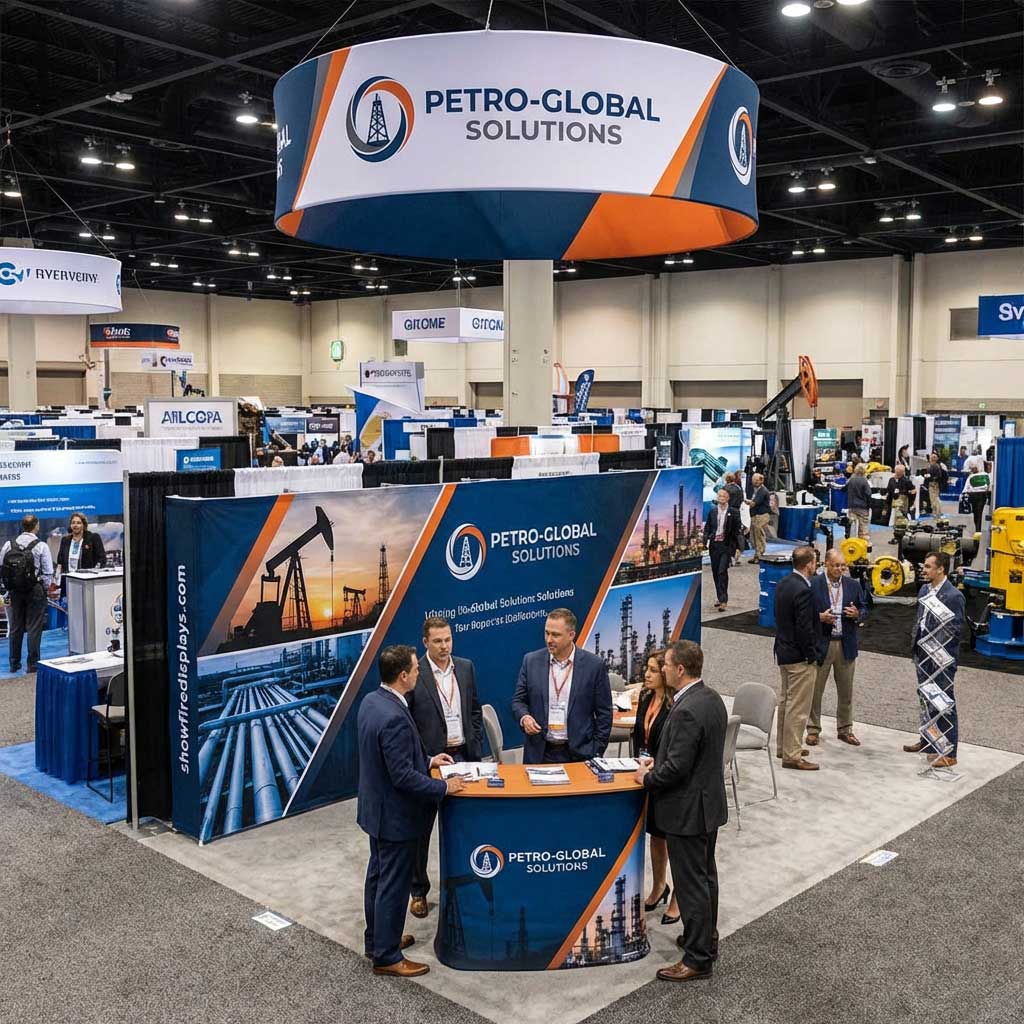
With so many types, sizes, and configurations available, here’s a practical decision framework to narrow your options.
Your booth space dimensions dictate your maximum display size. Measure your allocated space and choose a display width that fills the back wall without crowding your functional area. For a standard 10×10 inline booth, a 10ft fabric pop up is the natural choice. For a 10×20 space, consider either a single 20ft unit or two 10ft units.
If you’ll be setting up alone — which is common for small business exhibitors — prioritize lightweight tube-frame systems with pillowcase graphics. These are the easiest to assemble solo. Accordion-style pop ups are also manageable for one person but can be slightly more cumbersome due to the expanding frame mechanism. See how to set up a fabric pop up display in under 10 minutes for the full walkthrough.
If your messaging changes frequently — perhaps you promote different products at different shows — choose a system that separates the frame from the graphic cleanly. Tube-frame systems with zip-on pillowcase graphics excel here because ordering a replacement graphic is affordable and swapping it takes minutes.
If you’re flying to shows, weight and packed size matter enormously. Look for systems that pack into carry bags you can check as airline luggage. If you’re driving or shipping, you have more flexibility — consider a wheeled molded case that doubles as a counter at the show.
A fabric pop up rarely works alone. Most exhibitors build a complete booth environment by pairing their backwall with additional display elements. Adding retractable banner stands at the front corners of your booth creates depth and frames your space. A branded table throw adds cohesion to your presentation table.
For exhibitors wanting to take their booth to the next level, consider how your fabric pop up integrates with other display systems. If you need overhead presence to draw attention from across the show floor, a hanging banner display suspended above your booth can be a game-changer — though these typically require an island booth with no neighboring exhibitors sharing your walls.
Fabric pop up displays occupy a sweet spot in the trade show display market — they’re significantly more affordable than custom-built exhibits or modular trade show displays, yet they deliver a far more professional appearance than basic banner stands or foam board setups.
Entry-level 10ft fabric pop up systems typically start in the $500-$800 range, including the frame and a single-sided custom printed graphic. Premium systems with features like built-in lighting, monitor mounts, and higher-grade hardware can range from $1,000 to $2,500+. When you’re ready to see specific pricing, you can shop fabric pop up displays to compare options.
The first choice most buyers face is the graphic material. Older pop up displays used rigid vinyl panels or laminated vinyl graphics; today most exhibitors choose fabric. The same trade-off applies to banners in general, so if you have ever compared a vinyl vs fabric banner, the reasoning below will sound familiar.
| Factor | Fabric (dye-sublimation) | Vinyl |
|---|---|---|
| Weight and packing | Light; folds into a carry bag | Heavier; rigid panels need hard cases |
| Glare under show lighting | Matte finish, little glare | Glossy finishes can reflect overhead lights |
| Creases | Tension pulls most wrinkles out; steam the rest | Folds and dents tend to stay |
| Wear | Ink is in the fibers, so it does not crack or peel | Surface print and laminate can scratch or peel over time |
| Cleaning | Most graphics are machine washable (cold, air dry) | Wipe clean only |
| Changing the graphic | Order a new fabric graphic, keep the frame | Panels are often replaced as a set |
| Best for | Frequent travel, indoor shows, photo-quality color | Outdoor or wet conditions, very low budgets |
For a portable backwall that travels to several shows a year, fabric is the better buy in almost every case. Vinyl still makes sense for outdoor signage that will see rain or will not be packed and unpacked.
Understanding how fabric pop ups compare to alternative display systems helps ensure you’re investing in the right solution for your needs.
Roll up banner stands are the most portable and affordable display option available — they pack into a compact base and take seconds to deploy. However, a single banner stand is narrow (typically 33-47 inches wide) and works best as an accent piece rather than a full backwall solution. Fabric pop ups provide a much larger branded surface area and a more immersive booth experience.
Many exhibitors use both: a fabric pop up as the main backwall and banner stands flanking the front of the booth for targeted messaging. Our side-by-side of fabric pop up displays vs banner stands goes deeper.
If you want the dramatic “wow factor” of illuminated graphics, backlit fabric displays use LED light panels behind a translucent fabric graphic to create a glowing, sign-like effect. Backlit displays are stunning, but they’re heavier, more expensive, and require access to electrical power at your booth. Fabric pop ups are lighter, more portable, and don’t need electricity — making them the better choice for exhibitors who prioritize simplicity and portability. For the full breakdown, read fabric pop up vs SEG backlit displays: pros and cons.
Modular display systems offer reconfigurable components that can be rearranged into different booth configurations — great for companies that exhibit in varying booth sizes throughout the year. However, modular systems are typically more expensive, heavier, and more complex to set up. Fabric pop ups are the better choice when you need a straightforward, purpose-built backwall at a lower price point.
For an industrial or high-tech aesthetic, aluminum truss systems create an impressive structural framework. Truss displays are dramatic but heavy, expensive, and time-intensive to assemble. They’re best suited for larger booths (20×20 and above) where the scale justifies the investment. For standard inline booths, a fabric pop up delivers a polished look at a fraction of the cost and effort.
| Criteria | Fabric Pop Up | Banner Stand | Backlit Display | Modular System |
|---|---|---|---|---|
| Setup time | 10-15 min | 1-2 min | 15-30 min | 30-60+ min |
| Weight (10ft) | 15-30 lbs | 8-15 lbs | 40-80 lbs | 50-150+ lbs |
| Portability | Excellent | Excellent | Moderate | Low-Moderate |
| Visual impact | High | Moderate | Very high | Very high |
| Graphic updates | Easy & affordable | Easy & affordable | Easy, moderate cost | Moderate |
| Price range (10ft) | $500-$2,500 | $150-$500 | $1,500-$5,000+ | $3,000-$15,000+ |
| Power required | No | No | Yes | Sometimes |
Almost every fabric pop up graphic is made with dye sublimation fabric printing, and knowing how it works explains why fabric graphics look and wear the way they do.
That is why a sublimated graphic has no surface to crack or peel, can go through a gentle wash, and shows a soft matte finish instead of a shiny one. It is also why sublimation works only on polyester: natural fibers like cotton do not accept the dye. Printing methods that sit on the surface, such as UV printing on vinyl, can be sharp too, but the ink stays on top of the material where it can scuff.
For artwork, supply files at full print size with at least 150 DPI for photos (300 DPI for anything viewed up close), keep text and logos inside the safe area, and extend background color into the bleed so nothing important wraps around the frame edges.
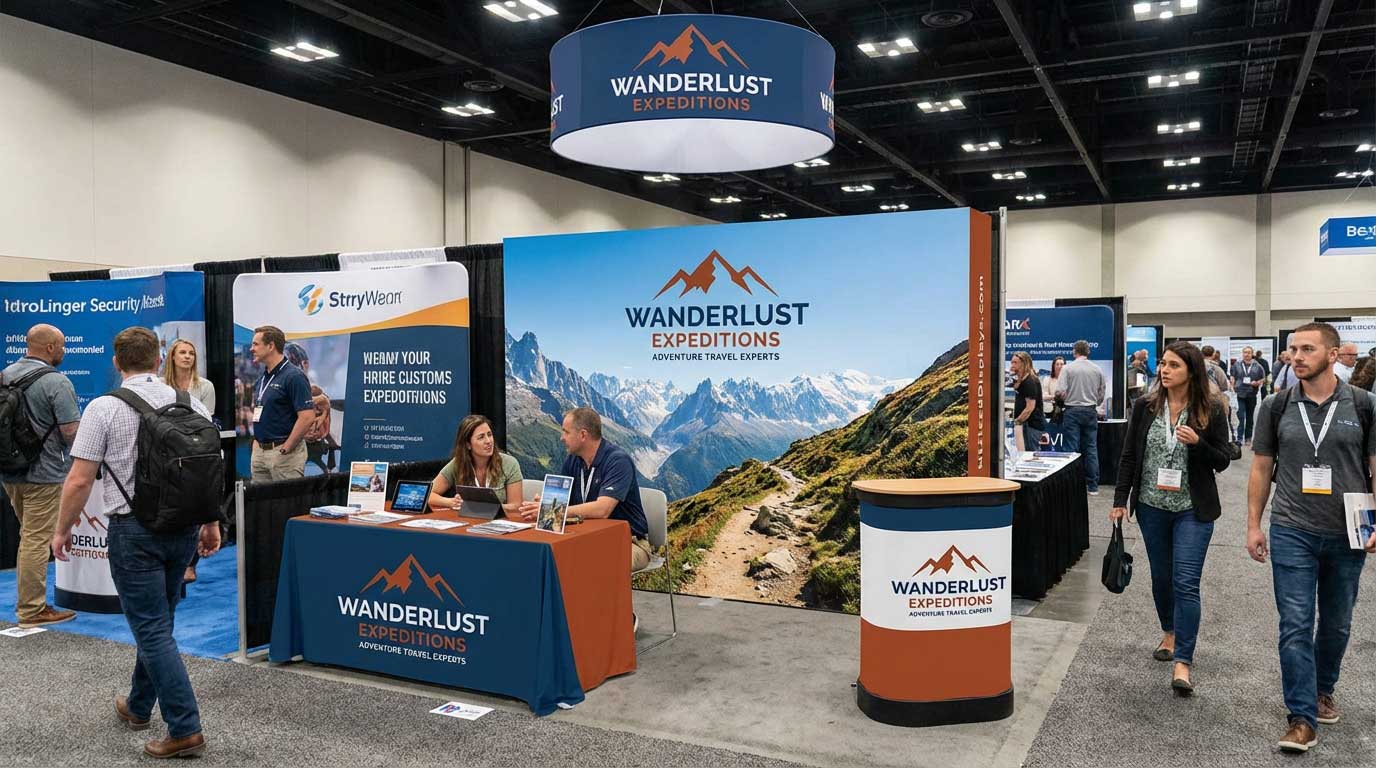
The effectiveness of your custom backdrop display depends heavily on the quality of your graphic design. Even the best hardware looks underwhelming with poorly designed artwork. Here are key design principles to follow.
Trade show attendees are walking past your booth at a pace, scanning dozens of displays in seconds. Your graphic needs to communicate your brand identity and core message in under three seconds. Use large headlines, minimal text, and high-contrast color schemes. Save the detailed product specs for handouts and conversations.
Your fabric pop up graphic should feel like a seamless extension of your brand. Use your official brand colors, fonts, and logo placement guidelines. When your backwall display, table covers, and any flanking banner stands all share a unified visual language, your booth looks intentional and professional.
Dye-sublimation printing can reproduce stunning photographic detail — but only if you supply high-resolution source files. Aim for images at 150 DPI at full print size as an absolute minimum. Ideally, work at 300 DPI for any element that will be viewed up close.
Remember that your graphic won’t be viewed in isolation. Tables, monitors, product displays, and even people will block portions of your backwall. Place your most critical branding elements — logo and tagline — in the upper third of the graphic where they’ll always be visible above the crowd. Our guide on where to place your logo on a fabric pop up shows the placements that work, and the biggest graphic design mistakes on fabric pop ups covers what to avoid.
If your booth is positioned in a location where attendees will pass behind it — such as an end-cap or island configuration — consider a double-sided graphic. This ensures your brand message reaches foot traffic from both directions. Even if your current booth is inline, having a double-sided option future-proofs your display for changing booth assignments. Compare the options in single vs double-sided fabric pop up displays.
Protecting your investment means proper care and maintenance. Here’s how to keep your fabric pop up looking its best for years.
A well-maintained dye-sublimation fabric graphic can last through 30-50+ events before colors begin to fade noticeably. The primary enemies of graphic longevity are UV exposure, harsh detergents, and physical abrasion. Treat your graphics gently, and they’ll reward you with years of vibrant service. For realistic lifespans of frames and graphics, see how durable fabric pop up displays are.
Most fabric pop up displays can be assembled by one person in 10-15 minutes without any tools. Tube-frame systems with pillowcase graphics are the fastest — simply connect the tubes, slide the graphic over the frame, and zip it closed. Our step-by-step setup guide has the details.
Absolutely. One of the biggest advantages of fabric pop up systems is that the graphic and frame are separate components. When your messaging, branding, or product lineup changes, you simply order a new fabric graphic and reuse your existing frame. This typically costs 40-60% less than purchasing a complete new system. Learn more about replacing graphics on fabric pop up displays.
Yes. Quality aluminum frames are engineered for repeated assembly and disassembly, and dye-sublimation printed polyester graphics are remarkably resilient. With proper care, most frames last 5-10 years, and graphics remain vibrant through dozens of events.
RPL stands for “Replacement Pillow-case Lined,” which refers to the pillowcase-style fabric graphic that slips over a tube frame. An RPL fabric display is essentially a type of fabric pop up — specifically, one that uses a tube frame with a zip-on graphic rather than an accordion frame with velcro or magnet-attached panels. The terms are often used interchangeably in the industry.
Many fabric pop up systems offer compatible accessories including monitor mounts, literature shelves, spotlights, and counters. Availability varies by manufacturer and frame style, so check accessory compatibility before purchasing. Tube-frame systems are often more limited in accessory options compared to accordion-style pop ups, which typically feature more attachment points.
For most fabric pop up displays, no. The tool-free, one-person setup is a key selling point. However, for very large configurations (20ft+ or multi-unit setups), having a second person can speed up assembly and reduce stress. If you’re exhibiting at a large convention center, be aware that some venues have labor rules that may affect your setup process. Your trade show marketing strategy should account for these logistics well in advance.
Most systems pack into soft-sided carry bags or padded wheeled cases. A typical 10ft system in its case weighs 20-35 pounds and measures roughly 10-16 inches in diameter by 36-48 inches long — compact enough to check as airline luggage or ship via UPS or FedEx Ground. Packing tips are in how to travel with fabric pop up displays.
A fabric pop up display is the foundation of your booth, but the most successful exhibitors layer multiple display elements to create an immersive brand environment. Here are some complementary additions to consider.
For outdoor events or shows with outdoor components, a branded canopy tent provides shelter and branding simultaneously. If you need vertical accents to break up your booth’s sightlines or highlight specific products, a tower display adds height and dimension alongside your backwall.
When evaluating all these options together, our trade show displays guide provides a comprehensive comparison that helps you understand how each display type fits into different booth configurations and budgets.
Before you order, it is worth reading the 10 most common fabric pop up display mistakes exhibitors make. If you are building the business case, see how fabric pop up displays improve trade show ROI and the industries where fabric pop ups work best. And if your current booth feels tired, check the signs your trade show display is hurting your brand.
Fabric pop up displays have earned their place as the most popular backwall solution in the trade show industry — and for good reason. They combine stunning visual impact with practical portability, fast setup, easy graphic updates, and accessible pricing. Whether you’re building your first booth or upgrading from an older display system, a well-chosen fabric pop up will serve you reliably for years of events.
The key is matching the right type, size, and configuration to your specific exhibiting needs. Consider your booth dimensions, your setup resources, your portability requirements, and your long-term branding strategy. And remember — the frame is a long-term investment, while the graphic is an easily replaceable component that can evolve with your brand.
When you’re ready to explore specific products, pricing, and package deals, browse the full pop up display collection — 5ft, 8ft, 10ft, 15ft, 20ft and 30ft fabric pop up displays — to find the perfect system for your next event. Our team is here to help you choose the right configuration, design your graphics, and ensure you show up to every event with a booth that turns heads and drives results.