Need Assitance?
Call us at 844-203-6588.
We Accept

Picking the right pop up display for a trade show booth involves more than choosing a width. You're deciding how your brand fills a wall, how quickly your team can set up under show-day pressure, and whether the hardware you buy this year will still be working three seasons from now. This category page covers every size and configuration Showfire Displays carries -- from compact 5ft backwalls to sweeping 30ft installations -- so you can compare options side by side, understand what each size is built for, and order with confidence. If you're early in your research and want a deeper breakdown of materials, graphic file specs, and configuration trade-offs, the fabric pop up display guide is the right place to start before you commit.
Not all pop up display hardware performs the same way. The older generation of pop up displays used vinyl or PVC graphics stretched or clipped onto a rigid bowed frame -- functional, but heavy, slow to set up, and hard to store wrinkle-free. The fabric format replaced that workflow with a lightweight aluminum frame that expands accordion-style and a pillowcase-style fabric graphic that zips or wraps directly over the frame.
The result is a display that one person can set up in under ten minutes, ships in a rolling carry case that fits in an SUV, and produces photographic-quality graphics without the glare that printed vinyl creates under show-hall lighting. The dye-sublimation printing process drives ink directly into the fabric fibers rather than sitting on the surface, so colors stay vivid show after show without cracking or fading. Compare that to a legacy vinyl backwall, where surface-applied ink begins showing micro-cracks after three or four rollups, and the advantage becomes obvious on a multi-year cost basis.
Every display in this collection uses rpl fabric -- a tightly woven polyester that accepts dye-sub ink at high resolution and maintains consistent tension across the frame without sagging. RPL fabric is machine washable, wrinkle-resistant in transit, and substantially lighter per square foot than vinyl, which matters when you're managing shipping costs or carrying cases up convention center stairs. It also holds true color across the full surface area, so a gradient or photographic background looks as clean at the edges as it does at the center.
A fabric trade show display also performs better under the mixed lighting conditions typical of convention halls. Vinyl reflects overhead spotlights, creating hotspots that wash out portions of your graphic in booth photos and video. Fabric diffuses light evenly, meaning your branding reads consistently from every angle and distance -- a practical advantage when attendees are photographing your booth or when you're capturing marketing content at the show.
The collection runs from a 5ft backwall suited for small booths and corporate lobbies all the way to a 30ft configuration that spans an inline exhibit the length of a school bus. Each size ships with the aluminum frame, the dye-sublimated graphic, and a rolling carry case. Optional endcaps extend the graphic to the edges of the frame for a fully enclosed look, finishing off the display cleanly when it sits in open space rather than against a wall or drape.
Here is a quick reference for how each size maps to common booth spaces:
| Display Size | Approximate Booth Fit | Typical Setup Time | Best For |
|---|---|---|---|
| 5ft | Tabletop or small 5ft booth | 5 min, 1 person | Small events, lobby activations |
| 8ft | Standard 8ft backwall | 8 min, 1 person | 8ft inline booths, paired setups |
| 10ft | Standard 10ft booth backwall | 10 min, 1 person | 10ft inline -- most common size |
| 15ft | 15ft inline or end-cap space | 15 min, 2 people | Mid-size booths, double-wide setups |
| 20ft | 20ft inline or island component | 20-25 min, 2 people | Large inline booths, 10x20 spaces |
| 30ft | 30ft inline or combined layouts | 30-35 min, 2-3 people | Full island or sprawling inline booths |
Browse each size using the links in the sections below. If you want broader context on selecting display types across booth categories, the trade show displays buyer guide covers the full landscape from banner stands to full island exhibits.
The smaller two sizes in the lineup punch well above their physical footprint. The 5ft fabric pop up display is the most portable option in the collection -- the entire kit fits in a bag you can check as airline luggage or store under a trade show table between shows. It works especially well as a freestanding backdrop behind a product demo table, as a reception area accent, or as a second display inside a larger booth where you want a secondary branded zone without adding bulk. Corporate teams that travel frequently to regional events often keep a 5ft unit as a permanent carry-on piece of their event kit, simply because it's there when you need it and disappears when you don't.
The 8ft fabric display fits the standard 8ft backwall space that many regional shows and corporate event venues provide. It delivers a full-height fabric display wall without overflow on either side, and the straight configuration makes it easy to position flush against a pipe-and-drape backdrop or a hard-wall booth panel. Pair two 8ft units with a gap between them if you're working a wider booth and want to frame a monitor or product shelf in the center -- the symmetry reads intentional rather than improvised. That kind of modular thinking is worth keeping in mind as you scale up your exhibit program: individual units can be combined, repositioned, or redeployed independently as your booth space changes from show to show.
Both sizes are available with or without endcaps. Endcaps add a vertical fabric panel that wraps each side of the frame, finishing off the edges cleanly when the display sits in an open space rather than against a wall. Without endcaps, the exposed frame edges are visible from the side -- not a problem against a drape, but noticeable in open-floor configurations.
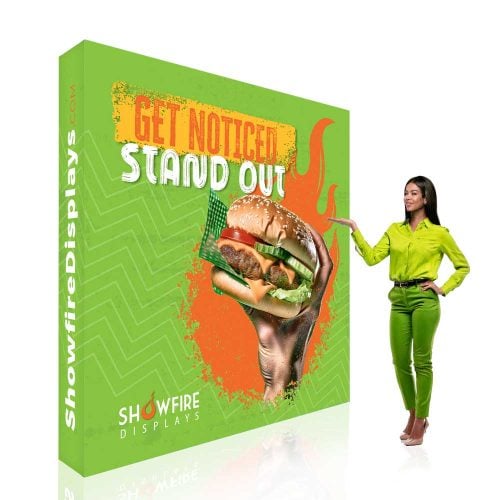
The 10ft fabric pop up is the single most popular configuration for trade show exhibitors, and for straightforward reasons: a 10ft inline booth is the default starting space at the majority of trade shows in North America, and this display fills that backwall cleanly with no excess and no gap. The expanded frame reaches from corner to corner, and the full-height graphic creates an uninterrupted visual surface that reads clearly from across a crowded aisle. When your booth neighbors on both sides have banner stands and pipe-and-drape, a full fabric backwall display at this width creates a noticeably sharper presence.
This size is available in straight and curved configurations. A straight tension fabric display sits flat against the back of the booth and gives you the maximum depth for tables, counters, and demo equipment in front of it. The curved configuration bows slightly forward at the center, creating a subtle three-dimensional depth that draws the eye -- useful if the booth is in a high-traffic area where you want to break the flat-wall visual rhythm. The curve also makes the display slightly more self-supporting, which can be helpful on uneven or carpeted convention floors.
For most exhibitors -- especially those attending multiple shows per year -- the 10ft size offers the best balance of graphic impact, portability, and storage footprint. The case doubles as a display counter with the included conversion kit, which saves you from renting or shipping a separate furniture piece to every show. That counter-case combination is one of the more practical features in this format: it reduces what you need to bring, shrinks your drayage bill at larger shows, and gives you a branded surface at the front of the booth rather than a generic draped table.
Two adjacent 10ft booths, a corner space, or a custom 15ft island layout all call for a display that covers more ground than a single standard unit. The 15ft fabric backwall fills that gap -- wide enough to dominate a mid-size booth without requiring a multi-section modular build that adds setup time and complexity. Exhibitors who have tried two separate 10ft units side by side often describe the gap or alignment issue that appears mid-show; a purpose-built 15ft frame eliminates that problem at the source.
The 15ft configuration ships as a single integrated frame rather than two separate units bolted together, which keeps the graphic seamless. There's no center seam, no alignment issue between panels, and no risk of a gap appearing mid-show when a connection loosens. If your brand runs a continuous visual across the backwall -- a panoramic photo, a gradient, an oversized logo -- this format preserves it the way a split display cannot. A seamless 15ft graphic is particularly effective for lifestyle or brand-story imagery where visual continuity is part of the message.
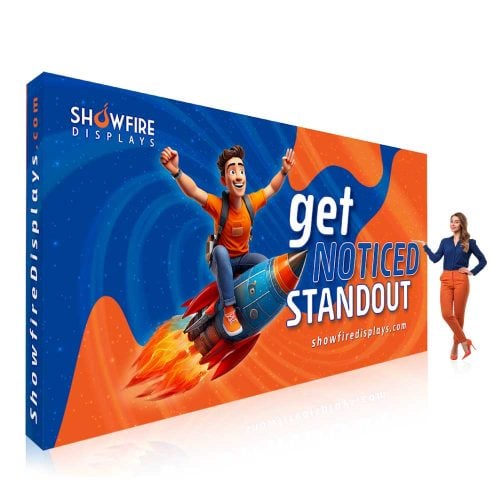
The 20ft fabric pop up display steps up for 10x20 and 20ft inline spaces. This is the standard choice for brands that exhibit in double-wide booths at major trade shows. At 20ft, the display creates a genuine room-defining backdrop -- long enough that attendees walking past can read your headline, process your visual, and turn toward the booth before they've even reached the corner of your space. As a backwall display at this scale, it does the work of orienting the entire exhibit, giving salespeople a backdrop that reinforces the conversation happening in front of it.
At this size, logistics planning matters. The 20ft display ships in two rolling cases, and setup involves connecting the frame sections before stretching the graphic over the assembled structure. Budget about 20 to 25 minutes for a two-person setup, and walk through the assembly once before show day if this is your team's first time with this format. The trade-off in setup time is worth it for the visual scale you get -- a 20ft fabric backwall reads as a serious investment in booth presence, and that perception translates directly to how attendees engage with your space.
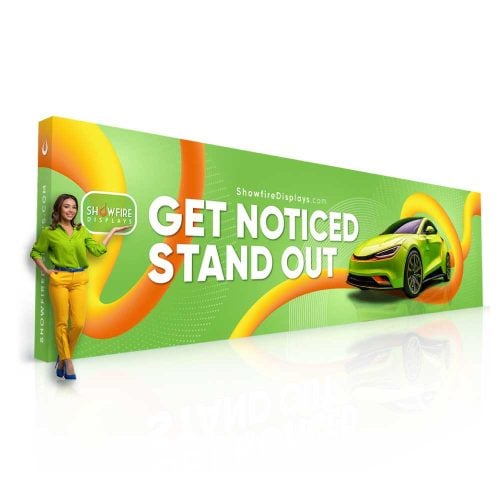
The 30ft fabric pop up display with graphics is built for exhibitors who occupy the kind of prime real estate at major industry shows -- a 30ft inline, a 10x30 space, or a wide island component that anchors one end of an exhibit hall. Very few display formats can fill this footprint with a single continuous branded surface. This one does, and without the structural complexity of a custom modular build that requires professional installation labor.
As a trade show pop up backdrop at this scale, the 30ft configuration creates a visual anchor for the entire booth -- something that orients attendees from a distance and signals to the room that this exhibitor is serious about its presence. When competitors are working 10x10 and 10x20 spaces, a 30ft fabric display wall reads at a completely different scale. The same rpl fabric and dye-sub graphics used across the full lineup appear here at full width, meaning print quality is consistent whether you're ordering a 5ft or a 30ft unit.
Setup requires a team and a plan. The 30ft display ships in multiple rolling cases and assembles from connected frame sections. Factor in the connection time when planning your show-floor schedule, and assign at least two people -- ideally three -- to setup and breakdown. The investment in setup effort is front-loaded: once the frame is assembled and the graphic is on, the display is stable and requires no ongoing attention during the show. Breakdown is faster than setup, and with a practiced team it becomes a reliable part of the post-show routine.
The simplest sizing rule: match the display width to your booth width. A display that's noticeably narrower than your booth looks undersized; one that's wider than your booth is a logistics problem. In practice, most exhibitors fall into one of three scenarios, and the decision often becomes clear once you know your booth dimensions and how many people you have available for setup.
Standard inline booth (10ft): The 10ft curved fabric pop up display is the correct choice for the overwhelming majority of 10ft inline booths. It ships in one case, sets up in under ten minutes, and fills the backwall without overflow. The curved option adds a subtle forward lean to the frame; the straight version sits flush against the back wall if you need the extra depth.
Double-wide or island booth (20ft or 30ft): If you're working a 20ft space, the 20ft straight fabric pop up display covers it end to end. For anything wider, the custom 30ft fabric pop up display handles it in a single seamless unit, avoiding the alignment and seam issues that come with combining separate displays.
Small booth or secondary display: The 5ft fabric pop up for trade show and 8ft fabric pop up with case are the right tools for tabletop setups, small event spaces, and booths where a second branded zone adds value without consuming floor space. Both are light enough to travel without freight and compact enough to store in an office between events.
Beyond size, the straight vs. curved choice matters. Straight configurations fit flush against walls and are the right call for booths where you need maximum depth for furniture, product displays, or demo equipment. Curved configurations work better in open-space settings where three-dimensional depth helps the display read from an angle and creates a subtle sense of enclosure. The complete fabric pop up display guide walks through the trade-offs between straight and curved in detail, along with guidance on endcap selection and frame care, if you want to dig into that decision before ordering.
Endcaps are worth a dedicated decision too. If your display sits in an open space or at the end of an aisle where attendees approach from the side, endcaps finish the look. If your display is positioned against a hard wall or standard pipe-and-drape, you may not need them -- the side of the frame is hidden by the booth boundary. Each product page shows both options clearly so you can see exactly what the finished display looks like with and without them.
Every fabric pop up display in this collection prints at high resolution using dye-sublimation on RPL fabric. The pillowcase-style graphic fits over the frame like a sleeve and zips closed -- no tools, no adhesive, no alignment guesswork. When you need updated messaging for a new product launch or a rebrand, you order a replacement graphic and swap it onto the existing frame. You don't replace the hardware.
This separation between frame and graphic is one of the real long-term cost advantages of a fabric format over a printed vinyl backdrop display. A vinyl graphic is typically retired with the frame, or at least with the tube it's wound around -- it doesn't separate cleanly and can't be swapped independently. A fabric pop up display frame, by contrast, can carry multiple generations of graphics across several years of shows without showing wear, as long as you store it properly and keep the connectors clean. Brands that exhibit three to five times a year often get four to six graphic updates out of a single frame before they consider replacing the hardware.
The most common graphic file requirements are high-resolution PDFs or flattened PSD/AI files with bleed. Exact dimensions, resolution standards, and color profile requirements vary by configuration, and full file specifications -- including how to handle bleed on curved vs. straight frames -- are covered in the rpl fabric pop up display reference on this site. Reviewing those specs before you finalize your artwork will save a round of revisions at the production stage.
One practical note on fabric pop up banner graphics: because the fabric is a pillowcase that zips over the frame, the graphic needs to be sized with the frame's exact expanded dimensions in mind, not the nominal display size. A "10ft" display doesn't always expand to exactly 120". Each product page lists the precise expanded dimensions for that configuration -- reference those numbers when you set up your artwork file.
The backdrop display format -- meaning a full-height fabric graphic covering the entire back wall of a booth -- is the most common use for pop up displays at trade shows, but it's not the only one. These displays also work as room dividers in open-plan conference spaces, as branded photo backdrops at corporate events, and as freestanding signage in retail environments where temporary branding is needed. The portability and self-contained carry-case design make deployment straightforward in settings that have nothing to do with a convention hall.
For trade show use specifically, the straight-wall format is the workhorse. Straight tension fabric displays sit flush, leave the maximum depth for furniture and equipment, and look clean in photos and video shot from the aisle. The curved version adds dimension but reduces the usable booth depth by a few inches at the center -- a worthwhile trade for some spaces, less so for compact booths where every inch of depth counts. If your booth also includes a monitor arm or product shelf mounted to the backwall, the straight configuration accommodates those additions more naturally.
If your exhibit involves multiple display types -- perhaps a fabric backwall combined with a banner stand or a tension fabric display at the sides -- the portable trade show displays buyer guide covers how to combine formats into a coherent exhibit layout. Mixing display types is common at mid-size booths where a primary backwall carries the brand message and secondary displays direct foot traffic or provide product-specific information at different points within the space.
Most exhibitors shopping for a trade show backdrop want the same thing: a seamless, full-color wall behind the booth that sets up in minutes and packs into one case. That is exactly what a fabric pop up display is. The collapsible aluminum frame expands to full size, the dye-sublimated fabric graphic attaches with Velcro, and you have an edge-to-edge branded wall with no seams or wrinkles.
For a standard 10x10 inline booth, the 10ft fabric pop up display is the classic full-width trade show backdrop. In tighter spaces or as a tabletop-height accent, the 8ft fabric pop up display fits the bill, and for 10x20 and larger booths the 20ft fabric pop up display covers the full back wall. Add endcaps for a finished, wrap-around look. Every size ships as a complete kit, so these trade show backdrops arrive ready to stand up at your next event.
Every size, every configuration, and every accessory option is available to configure and order directly on this site. Start with your booth width, choose between straight and curved, decide on endcaps, and upload your graphic at checkout. Production and shipping timelines are listed on each individual product page, so you can confirm whether the schedule works before you place the order.
Browse the full lineup: the 5ft fabric backwall for small and portable setups, the 8ft fabric pop up display with graphics for standard 8ft booth spaces, the 10ft fabric pop up display with graphics for the most common trade show footprint, the 15ft fabric pop up with case for mid-size inline and corner booths, the 20ft fabric pop up display for double-wide spaces, and the 30x8 fabric pop up display for major inline installations. If you're still comparing display formats and want to see how fabric pop up displays stack up against other booth display types across every price point and booth size, the full trade show exhibits guide covers that comparison in depth.