Need Assitance?
Call us at 844-203-6588.
We Accept

Vertical structures occupy a unique position in the trade show toolkit: they do not compete for floor space the way large inline exhibits do, yet they carry your brand messaging high enough to be visible across a crowded hall. Tower displays are purpose-built for that role -- compact in footprint, tall in presence, and fast enough to set up that a single person can have one ready before the show floor opens. This page is your starting point for browsing every tower configuration Showfire carries, understanding what separates one style from another, and making a confident buying decision before you place your order.
Most exhibitors arrive at a show with a specific problem: a modest booth space, a limited crew, and a short setup window. A display tower addresses all three constraints at once. Because the structure is vertical rather than horizontal, it occupies a small floor footprint -- often as little as 24" x 24" -- while projecting fabric graphics to heights of 8', 9', or more. That height advantage is significant; your branding stays visible even when adjacent booths fill in with banners, tables, and product displays.
Tower displays are also logistically efficient. The frames in this collection break down into manageable components, pack into portable carry cases or bags, and typically weigh far less than modular truss or panel systems. For a marketing team running a multi-show schedule, that ease of transport compounds quickly into meaningful time and cost savings across a full season.
If you are newer to this product category and want a thorough orientation before you shop, the tower display guide covers vertical display anatomy, material options, and configuration logic in detail -- a useful read before committing to a style.
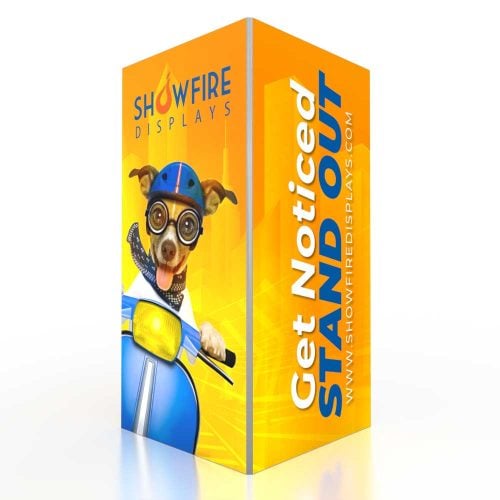
The first major category in this collection is the backlit tower line. These displays integrate LED lighting directly into the frame, illuminating the fabric graphic from behind to produce a lightbox-quality finish. For brands that exhibit in dimly lit convention halls or want their booth to read clearly from a distance, a backlit tower display is consistently one of the highest-return additions to a show kit.
Backlit graphics behave differently than front-lit printed fabric. Colors appear more saturated, gradients render more smoothly, and photographic content gains a depth that flat printing cannot replicate. Because the light source is even and internal, there are no hot spots or shadows -- the panel glows uniformly from edge to edge.
Here is a quick comparison of what backlit towers offer relative to non-illuminated versions:
| Feature | Backlit Tower | Non-Backlit Tower |
|---|---|---|
| Graphic visibility in low light | High | Moderate |
| Color vibrancy | Enhanced by backlighting | Standard print fidelity |
| Power requirement | Yes (standard outlet or battery) | None |
| Setup complexity | Slightly higher (LED connection) | Simpler |
| Weight | Moderately heavier | Lighter |
| Best use case | Evening events, dim halls, premium brand feel | Bright venues, outdoor events, fast setup priority |
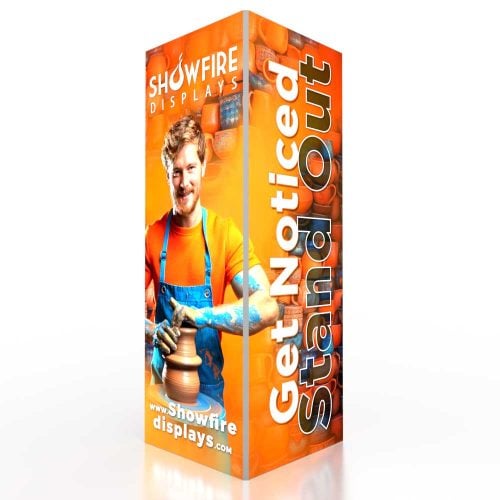
The sky backlit tower display in this collection uses a dye-sublimation fabric graphic system, meaning the graphic is heat-pressed into the fabric rather than printed on top of it. That process produces vivid color that does not crack, peel, or fade at the edges the way vinyl print can over repeated use.
A trade show tower that uses backlighting is also a natural conversation trigger. Attendees who might walk past a standard booth often slow down for an illuminated display, simply because the light signals something worth noticing. For brands in competitive categories -- consumer technology, lifestyle products, healthcare -- that extra attention has real value.
The second configuration in this collection is the non-backlit tower line. If the backlit version is built for impact in challenging lighting conditions, the non-backlit version is built for flexibility across every kind of venue and schedule.
A sky non backlit tower uses the same dye-sublimation fabric graphic system as its illuminated counterpart, so print quality remains sharp and the graphic swaps out easily for a new show or rebrand. The key difference is that there is no LED component -- which simplifies setup, reduces the packing weight, and removes the need to locate a power outlet near the display.
For outdoor events, pop-up retail activations, or venues where power access is unpredictable, a fabric tower display is often the more practical choice. The lighter load is also easier on a team that is breaking down and moving to a new city every few weeks.
Non-backlit towers are also typically more affordable than their illuminated counterparts, which matters when you are outfitting multiple booth spaces or adding a tower to an existing display kit as a supplementary structure. The reduction in exhibit tower cost can free up budget for other elements -- additional graphics, furniture, or flooring -- without sacrificing the vertical branding presence a tower provides.
The non-backlit version works equally well as a standalone display tower in a small 10' x 10' space or as a pillar display flanking a larger inline or island booth. Its clean silhouette and full-height graphic wrap make it a structurally coherent addition to almost any exhibit layout.
Choosing between backlit and non-backlit is the primary decision most buyers face, but there are several other variables worth thinking through before you order. The table below summarizes the key factors:
| Decision Factor | Questions to Ask | Recommendation |
|---|---|---|
| Venue lighting | Is the hall well-lit or dim? Will you exhibit at evening events? | Dim or evening venues: backlit. Bright venues: either. |
| Power access | Is there an outlet within reach of your footprint? | No reliable power: non-backlit. |
| Travel frequency | How many shows per year? How far does the kit need to ship? | Heavy travel: prioritize lighter non-backlit. |
| Brand positioning | Does your category expect premium visual presentation? | Premium category: backlit adds perceived value. |
| Budget | What is the total available exhibit budget? | Tighter budget: non-backlit offers strong value. |
| Graphic update frequency | Will the graphic change between shows? | Both styles support fast graphic swaps. |
Beyond the backlit vs. non-backlit choice, consider how the tower will be used within your overall booth layout. A tower kiosk placed at the corner of your space draws attention from the aisle without blocking access to the interior. A tower booth used as the centerpiece of a small space needs a graphic that works from multiple viewing angles, since visitors will approach from different directions.
If you are managing a larger exhibit program and need to think through how towers integrate with other display types, the trade show displays buyer guide provides a comprehensive framework for matching display formats to booth sizes, show types, and budget tiers.
Tall, narrow display formats reward a different design approach than horizontal banners or backdrop walls. The following principles apply specifically to trade show tower displays and will help you get the most from your printed fabric:
Lead with your logo near the top. Visitors scanning a show floor look upward first. Logo placement in the upper third of the graphic ensures visibility even when the lower portion is partially obscured by tables or crowds.
Use bold, single-message hierarchy. A tower is not a brochure. Limit the graphic to one primary message -- a brand name, a product name, a single strong tagline -- and let that message breathe with generous negative space.
Design for viewing distance. Text at the mid-point of a 9' tower will be read from 15 to 20 feet away. Body copy at small point sizes is wasted. Stick to 36pt or larger for any text you want attendees to actually read.
Consider the full-wrap silhouette. Trade show towers with fabric that wraps around all four sides can carry different messaging on each panel -- useful if your booth sits at an intersection where traffic comes from multiple directions.
Match your color profile to the print method. Dye-sublimation output is calibrated to fabric, which absorbs color differently than paper or vinyl. Ask for a proof calibrated to the actual fabric substrate before approving final files.
The towers in this collection are designed to work in standard booth footprints without requiring excessive square footage. Most configurations have a base footprint in the range of 24" x 24" to 36" x 36", with heights reaching from 7' to over 9'. That means a single trade show tower leaves the vast majority of a 10' x 10' booth open for product displays, seating, or demo areas.
Setup for both the backlit and non-backlit styles follows a similar sequence: assemble the frame sections (most use push-button or bungee-connected poles), slip the fabric graphic over the frame, and -- for backlit models -- connect the LED strip. Most exhibitors complete setup in 15 to 20 minutes without tools.
For full frame dimensions, graphic file specifications, and carton weights, the product detail pages for the sky backlit with led configuration and the sky pillar display option each carry complete spec sheets. Reviewing those specs against your venue's ceiling height and freight allowances before ordering is always worthwhile.
Trade show towers are used across a wide range of industries and event types. Some of the most common deployment scenarios include:
For teams running a busy show schedule, trade show towers also solve a logistics problem that larger structures cannot: they ship economically, check as standard luggage on some flights, and require no special freight handling.
Pricing for tower displays generally falls into three tiers based on structure type, size, and graphic complexity.
| Tier | Typical Configuration | What Drives the Price |
|---|---|---|
| Entry | Non-backlit, single-sided fabric, standard height | Simple frame, one graphic panel |
| Mid-range | Non-backlit, multi-sided graphic wrap, taller profile | Additional fabric panels, larger format |
| Premium | Backlit, LED-integrated, full wrap | LED component, power supply, precision frame |
Entry-level exhibit tower cost is accessible for small businesses and startups who need a professional presence without a large exhibit budget. Mid-range configurations suit teams that exhibit regularly and want a more complete visual presence. The premium backlit tier is most common among established brands in competitive show environments where the lighting differentiation is worth the investment.
Replacement graphics are priced separately from frames, which matters for long-term cost planning. Because the frame is durable and reusable across many shows, the ongoing cost of ownership is primarily the graphic -- and fabric reprints are typically a fraction of the original kit price.
For buyers who want to understand where tower displays fit within a broader exhibit budget, the complete trade show displays buyer's guide includes a section on display type cost comparisons that is useful for planning purposes.
The fastest path to the right choice is usually a two-step filter. First, confirm whether you have reliable power access at your venue -- if not, the non-backlit line removes a variable from your planning. Second, look at your venue photos from previous years to assess ambient lighting. Bright, well-lit halls are forgiving of non-backlit graphics; darker halls reward the investment in a backlit structure.
If you want a deeper breakdown of frame types, graphic options, and how vertical displays compare to other exhibit formats, the freestanding tower display section of our pillar guide addresses those comparisons directly.
Once you know your lighting situation and power access, the choice between the illuminated sky tower and the custom sky tower becomes straightforward. Both ship with full graphic production, both reuse the same frame across multiple shows, and both are sized to fit standard 10' x 10' and larger booth spaces without modification.
The two configurations below are your entry points into the collection. Each product page includes complete specifications, graphic templates, and ordering details.
If you want guidance on which configuration fits your specific show schedule, venue type, or brand requirements, reach out to the Showfire team directly -- the goal is to get you into a structure that works hard for you every time it goes up.
Shop tower displays now and get your next show booth ready.