Need Assitance?
Call us at 844-203-6588.
We Accept

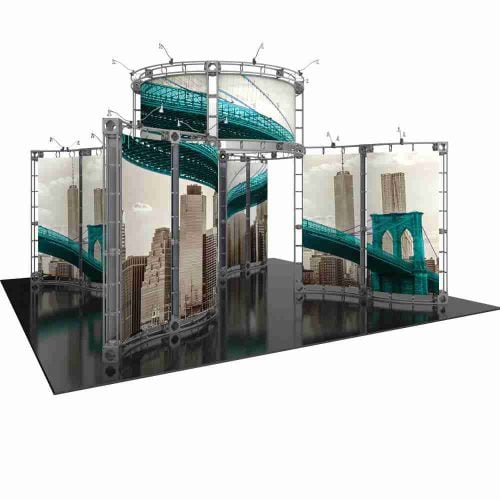
A 20 x 20 booth footprint represents a serious commitment -- more floor space, more visibility, and higher stakes for every show you attend. The orbital truss 20x20 is built specifically for exhibitors who need to fill that space confidently, with a rigid aluminum frame that anchors a full island configuration rather than a flat inline wall. Unlike fabric pop-up systems or modular panel displays, this format uses structural truss to create depth, height, and defined zones within the booth -- all while breaking down into cases that a small crew can manage without tools. If you are planning a double-digit booth and want a display that performs at that scale without requiring a contractor to assemble it, this page covers exactly what you need to know before ordering.
Most exhibitors start with a 10 x 10 or 10 x 20 inline booth and graduate to a 20 x 20 island after a few shows. The jump is not just dimensional -- it changes how attendees interact with your space. An island booth is approachable from four sides, which means your display needs to hold up visually from every angle, not just from the front.
The orbital truss 20x20 handles that challenge through its three-dimensional frame architecture. Horizontal truss runs can span across the top of the booth, creating overhead structure that reads clearly from across a crowded show floor. Vertical uprights define the perimeter and support mounted graphics, lighting bars, or monitor arms without requiring separate freestanding fixtures.
The result is a booth that has visual mass -- the kind of presence that makes a large footprint feel intentional rather than empty. That is not something a pop-up or banner stand can replicate at this scale, which is why truss is the format of choice for serious island exhibitors.
The 20x20 aluminum truss display is a natural fit for companies that exhibit at major industry events, national trade shows, or multi-day conferences where booth investment is expected to reflect brand stature. Here is a closer look at who this size serves best:
If you are newer to truss displays and want to understand what the system looks like at a smaller scale first, the orbital truss 10x10 is a useful starting point for context.
Choosing the right configuration at this size involves several decisions that go beyond picking a graphic. The sections below walk through the factors that matter most.
Every aluminum orbital truss in this lineup is built from lightweight aluminum alloy -- strong enough to support overhead signage, lighting rigs, and mounted monitors without flex or sag. The orbital connector system is a key differentiator: curved connectors replace traditional corner blocks, allowing the frame to assemble with fewer pieces and less friction than square-tube truss systems.
At the 20 x 20 scale, frame integrity matters more than it does in a compact 10 x 10 setup. Overhead spans are longer, uprights carry more cumulative load, and the structure may need to support multiple lighting positions. The aluminum orbital truss is designed with those demands in mind -- the connectors are precision-machined, and the tube sections are rated to carry meaningful point loads at their standard configurations.
The custom 20x20 orbital truss accepts both fabric and rigid panel graphics, and the choice between them affects the look, the pack-out weight, and the replacement cost down the road. Fabric panels are printed on dye-sublimated polyester, attach via hook-and-loop or sleeve systems, and pack flat or rolled for easy transport. Hard panels offer a stiffer, higher-gloss finish that reads well under direct light.
For a 20 x 20 island, most exhibitors use a combination -- fabric panels on the perimeter for broad brand messaging and hard panels or digital screens at key focal points inside the booth. The truss frame accommodates both without modification.
| Graphic Type | Pack Method | Best For | Replaceability |
|---|---|---|---|
| Dye-sub fabric | Rolled or folded | Large spans, lightweight | Easy, cost-effective |
| Rigid hard panel | Flat-packed in crates | Focal points, high-gloss finish | Moderate cost |
| Digital screen (mounted) | Separate AV cases | Video content, demos | Equipment-dependent |
Lighting is not an afterthought on a 20 x 20 truss exhibit -- it is a structural decision. Because the frame creates overhead runs, spotlights and wash lights can be clamped directly to the truss and aimed with precision. This eliminates the need for floor-based lighting stands that compete for booth floor space.
For a configuration at this size, plan for multiple lighting positions along the top chord of the frame. LED spotlights are the standard choice: low heat output, low power draw, and long bulb life reduce operating overhead across a multi-day show. You can learn more about lighting options in the broader orbital truss display category.
A 20x20 truss booth ships in multiple cases -- typically a combination of hardware cases for frame components and graphics cases or tubes for panels. Weight and case count will depend on your specific configuration and graphic choices. Plan freight accordingly: most 20 x 20 setups exceed the threshold for standard ground shipping and will require LTL freight or advance warehouse shipment to the show.
Setup time for a properly packed 20 x 20 orbital truss is typically achievable in a few hours with a two- to three-person crew. The orbital connector system speeds assembly compared to conventional truss, and component labeling helps crews orient sections correctly without referencing a manual at every step. Breakdown and repack follow the same logic in reverse.
For a broader orientation to truss systems -- including what to expect from freight, drayage, and on-site logistics -- the trade show truss system guide covers those topics in depth.
The orbital truss 20x20 is the largest standard configuration in the Orbital series, which makes it the top of the size range for exhibitors working within the platform. Below it, the 10x20 truss booth offers a strong inline option for exhibitors who need width but are not yet ready for a full island configuration. Both sizes share the same aluminum frame components and connector system, so teams that already own one size will find the upgrade path straightforward.
The 20x20 orbital truss kit includes all frame hardware and connectors needed to assemble the standard configuration. Graphics are configured separately based on your artwork and panel layout, giving you control over which surfaces carry full-bleed prints and which are left open for product display or monitor mounting.
For exhibitors who are earlier in the planning process and weighing all their display options -- from fabric pop-ups through custom truss islands -- the complete trade show displays buyer's guide is a useful reference before committing to a format. And if you want to understand how the Orbital system compares to other truss families available on this site, the exhibit display truss pillar guide maps out the full landscape.
The vesta 20x20 orbital truss exhibit is one of the named configurations available in this size range -- if you are looking to match a specific named package you have seen quoted or referenced, confirm the configuration with the Showfire team when you reach out.
A 20 x 20 island is where brands come to be taken seriously. The orbital truss 20x20 gives you the structural backbone to build a booth that holds its shape, carries your graphics cleanly, and breaks down efficiently at the end of the show -- without the cost or complexity of a custom fabricated exhibit.
Ready to get started? Contact the Showfire Displays team to discuss your booth objectives, graphic preferences, and show schedule. Whether you are configuring from scratch or upgrading an existing display, the right specification starts with a conversation. Reach out today and get your 20x20 configured for your next show.