Need Assitance?
Call us at 844-203-6588.
We Accept

Choosing a truss display for a trade show is a structural decision as much as a visual one -- you are committing to a framework that determines how your booth assembles, what lighting and hardware it can carry, and how many shows it survives before showing its age. Orbital truss changes that calculation in a meaningful way by combining the engineering strength of aluminum modular truss with a setup process that does not require a professional crew or specialized tools. If you have been weighing truss options and wondering whether the format is practical for a company that exhibits regularly without a dedicated install team, this is the category to understand first.
The orbital truss system is built around a circular connector design that locks truss sections together quickly and holds them under load without hardware rattling loose over repeated assembly cycles. Each section snaps into the hub, the structure squares itself, and the result is a booth frame that feels solid rather than provisional. That reliability matters at a show when you have a two-hour window to go from empty floor space to a finished exhibit.
Unlike pipe-and-drape or tension fabric frames, orbital truss displays carry the visual weight of a professional exhibit even before you add graphics or lighting. The aluminum extrusion itself reads as intentional -- a structural grid that signals permanence rather than portability. That distinction shapes how attendees perceive a booth before they have read a single word of copy.
For exhibitors who want to shop truss displays across the full range of available formats, the parent category covers all truss types and gives context for where orbital fits within the broader lineup. But for most inline and island booth exhibitors, the orbital system handles the broadest range of real-world show scenarios.
Orbital truss for trade show environments covers a wide range of exhibitor profiles, but the format is especially well-suited to four situations:
The format is less suited to single-event use where cost-per-show is a primary concern, since orbital truss carries a higher upfront cost than fabric pop-up alternatives. If budget is the primary filter, the complete trade show displays buyer's guide walks through how to match display type to budget range and show frequency before you commit to any category.
Three configurations make up the current orbital collection, each designed around a standard booth footprint. Understanding which footprint fits your floor space is the most important decision in the buying process, so here is a direct comparison of what each configuration is optimized for:
| Configuration | Booth Footprint | Best For |
|---|---|---|
| 10 x 10 | Single inline or corner | First-time truss exhibitors, compact booths |
| 10 x 20 | Double inline or peninsula | Mid-size inline runs, two-aisle exposure |
| 20 x 20 | Island or large corner | Island exhibits, maximum floor presence |
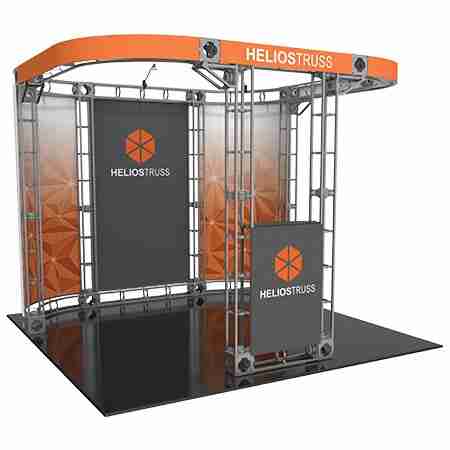
The 10x10 orbital truss is the entry point for exhibitors moving from a fabric backwall into a structural frame for the first time. It fits a single 10-foot booth without requiring additional floor space, and the compact footprint keeps logistics manageable -- the kit ships in a case that handles as standard freight.
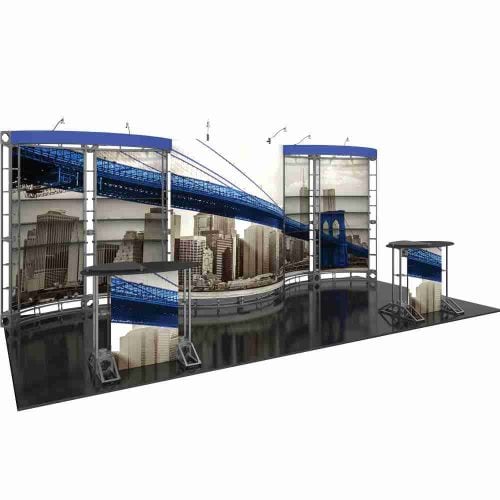
The orbital truss 10x20 doubles the footprint and opens up the display to two-sided exposure -- a meaningful advantage at shows where the booth faces aisles on two sides. This configuration is the most popular in the lineup because it fits the most common medium-size booth allocation without requiring an island permit.
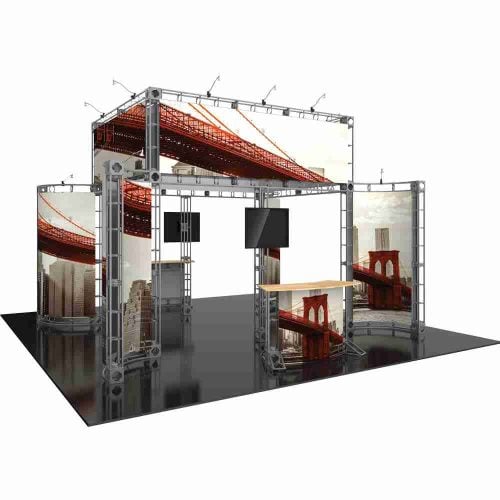
For exhibitors who have secured island space or need to anchor a 20 x 20 presence, the 20x20 truss booth provides the structural framework to build a fully enclosed or semi-open island exhibit. At this scale, the truss grid becomes as much architecture as display -- it defines a space rather than simply backing one.
All orbital truss displays use aluminum extrusion, which keeps the weight manageable while maintaining the load-bearing capacity needed to hang lighting and suspend fabric graphics. Aluminum does not corrode or warp in the humidity swings common to convention halls, and the finish holds up against the contact and friction of packing and unpacking. These are not cosmetic details -- they are the practical reasons a well-maintained orbital frame lasts years across dozens of shows.
The orbital system accepts both fabric graphic panels and hard-format graphic inserts, depending on the configuration. Fabric graphics are lighter, compress into bags for shipping, and can be swapped between shows when messaging changes. Hard panels offer a sharper surface finish at close viewing distances. Most exhibitors start with fabric and add hard-panel inserts to specific sections where they need fine-detail graphics, such as product close-ups or dense specification charts.
If you plan to add lighting -- and most serious exhibitors do -- the orbital truss with lights is one of the most practical configurations in the truss category because the horizontal chord gives you multiple clamping points without rigging hardware. LED wash bars and adjustable spotlights mount directly to the extrusion and aim at graphics or product displays on the floor below. Plan for lighting before you configure the frame so you choose the right chord height and confirm power drop access at your show venue.
A properly packed orbital truss display travels in standard rolling cases. The 10 x 10 configuration typically ships as a small number of cases manageable by a single exhibitor. The 20 x 20 configuration requires freight planning and a small crew for setup, though it remains far less complex than custom-built exhibit structures. If you need detailed guidance on evaluating truss before you buy, the trade show truss buying guide covers load ratings, connector types, and shipping logistics in depth.
If you are not certain orbital is the right truss format, it is worth looking at the origami truss display as a direct comparison. The origami system is designed around a folding panel mechanism that collapses the frame without fully disconnecting sections -- faster to deploy when floor time is extremely limited, but with different graphic-mounting options than the orbital connector system. Both formats live under the same modular truss display umbrella, and the right choice depends on how you weight setup speed against structural flexibility.
For a broader view of how orbital sits within the full world of truss exhibit options, the exhibit display truss pillar guide covers connector standards, span capabilities, and what to look for when comparing vendors.
You can order truss display online directly through Showfire Displays, with configuration options for graphics, lighting accessories, and case upgrades available at the product level. The three size pages -- the 10x10 truss display, the 10x20 truss exhibit, and the custom 20x20 orbital truss -- each include configuration details, graphic file specifications, and current pricing.
If you know your booth footprint, start at the matching size page and work through the configuration options. If you are still deciding between footprints or comparing orbital truss displays against other exhibit types, the complete trade show displays buyer guide gives you the framework to make that call before you spend. Either way, the next step is a click away -- and the buying process is straightforward from there.