Need Assitance?
Call us at 844-203-6588.
We Accept

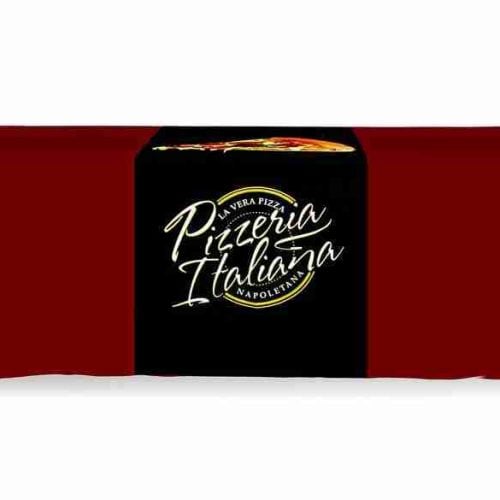
A table runner does something that a full cover cannot -- it layers brand detail directly in the center of the visual field, right where attendees' eyes naturally land. Custom table runners are a focused branding tool: narrower than a full throw, positioned front and center, and designed to work either alone on a bare table or draped over an existing cover for a polished, two-layer look. They are a smart choice for exhibitors who already have a table throw and want a sharper, more customized touch without replacing their entire setup. Whether you are refreshing a dated display or building a new one from the ground up, understanding how runners fit into the bigger picture will help you spend your display budget in exactly the right place.
There is a practical reason the table runner has become one of the most requested add-ons in event display: contrast. When a printed table runner with logo sits over a solid-color base cover, the graphic pops against a clean background rather than competing with a fully printed surface. The result is a layered, intentional look that reads as polished and deliberate -- even from across an aisle.
A branded table runner also gives you flexibility that a one-piece throw does not. You can swap runners between events to match different campaigns, seasonal themes, or co-branded partnerships, all while keeping the same base cover underneath. That reusability makes a runner one of the more cost-efficient items in your display kit.
For exhibitors working with a trade show table runner for the first time, the setup is straightforward: center the runner lengthwise on the table, let it hang past both ends at a consistent drop, and the graphic faces the aisle. No hardware, no frame -- just fabric and print.
Custom table runners serve a wide range of use cases, but a few scenarios make them especially useful.
Trade show and expo exhibitors reach for runners when they want a distinct brand moment at the table without the cost of reprinting an entire throw. A printed table runner paired with a neutral base cover delivers a fresh look each show cycle.
Retail and pop-up vendors use runners to mark a table as their own in a shared or multi-vendor space. The runner becomes a visual anchor -- it says "this table belongs to us" without requiring signage.
Corporate events and conferences benefit from runners when branding needs to be subtle. A table runner with logo placed on a catering or registration table signals professionalism while staying understated.
Nonprofits and community organizations often have limited display budgets. A custom table runner lets a group add polished branding to a borrowed or rented table without investing in a full custom throw right away.
Recurring events like farmers markets, craft fairs, and networking events are another natural fit. A runner handles repeated setup and teardown better than many people expect -- quality fabric holds up through dozens of events with proper care.
Shopping for a custom table runner involves a few decisions that are worth thinking through before you finalize an order. Here is what matters most.
Runners are sized to drape over the table and hang down on both ends. The standard tables at trade shows and events run at 6 ft or 8 ft long, and runners are typically sized to leave a consistent drop on each side. Confirm your table size before ordering -- a runner cut for an 8 ft table will look oversized and unbalanced on a 6 ft setup.
If you plan to use a table runner over cover (that is, layered on top of an existing throw), the base cover needs to match the table size as well. Mismatched sizing between the cover and the runner will shift the runner off center and undercut the clean look you are going for.
Most custom table runners are printed using dye sublimation, which bonds ink directly into the fabric fibers. The result is vibrant, accurate color that does not crack, fade, or peel the way screen-printed or heat-transfer graphics can. Dye sublimation also handles gradients, photography, and multi-color logos without any of the per-color cost increases you would see in older print methods.
For best results, submit artwork in vector format or at high resolution (typically 150 dpi at final print size). If your logo lives in a PDF, EPS, or AI file, you are in good shape. If you only have a small PNG from your website, ask about prepress support before you order.
Single-sided runners are printed on one face, which is all you need if the runner will be viewed from the front. Double-sided runners are printed on both faces, so the graphic is visible from any angle -- useful at island booths or round tables where guests approach from multiple directions.
Lighter fabrics travel easily and shake out wrinkle-free after being folded in transit. Heavier fabrics tend to drape more smoothly and look more structured on the table. Most runners are machine washable on a gentle cycle; always air dry to protect the print. A fabric carry bag makes storage between events easy and keeps the runner from picking up dust or snags.
A table throw and runner set is the most complete way to present a branded table. The throw covers the table fully, hiding the legs and any storage underneath, while the runner adds a graphic layer on top. If you have not yet chosen a base throw, our custom table covers hub is a good starting point -- it covers every cover style we carry in one place.
For a full overview of how table covers, runners, and other display elements fit together in a booth context, the custom table throw guide walks through material options, print methods, and setup tips in detail.
Not every throw pairs equally well with a runner. A solid or lightly branded base is usually the better canvas. If your base throw is already fully printed from edge to edge, a runner on top can create visual noise rather than clarity. In that case, consider a more neutral throw as the base.
A full color table throw works best as the primary graphic surface when your branding is complex or photography-heavy -- the runner may not add much in that scenario. On the other hand, a trade show table cover from our OneChoice line, which features a single-panel logo print on a solid background, pairs beautifully with a runner because the contrast between the solid base and the runner graphic is exactly where the visual interest lives.
If you prefer a cover with clean, structured lines, a fitted table throw gives the runner a smooth, taut surface to lie on -- no bunching, no shifting, just a flat backdrop for your graphic.
For exhibitors building out a larger display kit, it is worth reading through the complete trade show displays buyer's guide before finalizing your order. It covers how table-level branding fits into the broader booth layout, including banner stands, backdrops, and signage.
A runner is rarely the only display element at a well-built booth, and it does not have to be. Think of it as the table's headline -- the first thing a visitor reads as they approach. Everything else at the table (the cover, the products, the literature) supports that first impression.
Custom table runners are also one of the easiest items to update between event cycles. When a campaign changes or a co-sponsor relationship ends, a new runner is a fraction of the cost of a full throw reprint. That modularity is part of what makes them worth having in your display inventory.
Exhibitors who rely on their table as their primary brand surface -- particularly those at smaller shows without large backdrop budgets -- often find that a runner gives them the most visible branding return per dollar spent. It is a small piece of fabric that does a significant amount of work.
Showfire Displays makes it straightforward to get a runner that fits your table, matches your brand, and ships on a schedule you can plan around. Upload your artwork, confirm your table size, and our team will handle the rest -- from prepress review to production to shipping.
Browse the full range of table throw options alongside runners to build a complete table setup, or reach out directly if you have questions about sizing, print specs, or turnaround times. Your next event is worth showing up to with a table that looks like you planned it.