Need Assitance?
Call us at 844-203-6588.
We Accept

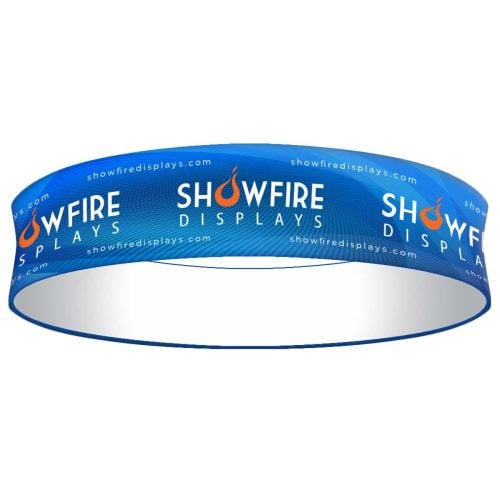
Overhead signage does a job that floor-level displays simply cannot -- it claims vertical real estate above your booth and pulls visitors in from across a crowded hall. A round hanging banner is particularly effective at this because the circular silhouette reads instantly from any angle, no matter how a visitor approaches. There are no corners to hide behind, no flat face that disappears when someone walks past the side of your exhibit. If you are trying to maximize visibility in a trade show hall, a convention center, or a large retail environment, the circle shape delivers consistent exposure that more angular formats can struggle to match. This page walks you through the full circle hanging banner line at Showfire Displays -- six sizes, one cohesive shape, and everything you need to know before placing your order.
Geometry matters more than most buyers realize when selecting a trade show hanging banner. A square or rectangle presents its full graphic width only when viewed head-on; rotate your viewpoint 45 degrees and the visual impact narrows. A circle, by contrast, projects the same diameter in every direction. That consistency means your logo and brand messaging read just as clearly from the aisle as from straight ahead.
Round hanging banners are also visually softer than rigid geometric shapes, which can make them feel more approachable in consumer-facing environments like retail pop-ups, wellness expos, and food-and-beverage showcases. The curved edge keeps the eye moving around the graphic rather than stopping at a corner -- a subtle effect that holds attention slightly longer.
For exhibit teams who want to compare shapes before committing, our full hanging signs collection covers every geometry in production. You can also dig into shape-by-shape guidance in the trade show hanging banner guide, which covers rigging requirements, visibility math, and booth-size recommendations for each format.
The circle format earns its keep across a wide range of environments and industries. Below is a quick breakdown of the settings where it performs best, along with the size range that typically fits each situation.
| Setting | Recommended Size Range | Primary Reason |
|---|---|---|
| 10ft x 10ft trade show booth | 5ft -- 8ft | Proportional overhead fill without overwhelming the space |
| 20ft inline or island booth | 10ft -- 12ft | Strong visibility from mid-hall distances |
| Large island exhibit (20ft+) | 15ft -- 20ft | Dominates the ceiling zone, readable from 100ft+ |
| Retail pop-up or in-store | 5ft -- 8ft | Fits standard retail ceiling rigging |
| Corporate event or conference | 8ft -- 12ft | Professional look, easy to brand with a clean logo lockup |
| Sports arena or stadium concourse | 15ft -- 20ft | Built for high ceilings and high foot traffic |
If your booth falls into the 10ft x 10ft category, the 5ft circle hanging banner is a proven starting point -- compact enough for a smaller footprint but still visible from a distance. Larger island exhibits tend to gravitate toward the 12ft circle hanging banner or the 15ft circle hanging banner for the kind of scale that reads across a packed show floor.
Choosing the right diameter is the single most consequential decision you will make. Too small and the banner disappears in a tall hall; too large and it may exceed venue rigging limits or dwarf your actual booth structure. As a rule of thumb, the banner diameter should be roughly 40-60% of your booth's shortest side length for proportional coverage.
The Showfire circle line runs from the 5ft circle hanging banner up through the 8ft circle hanging banner, 10ft circle hanging banner, 12ft circle hanging banner, and 15ft circle hanging banner, all the way to the flagship 20ft circle hanging banner. That range gives you a size for practically every venue ceiling height and booth footprint you are likely to encounter.
Every circle hanging banner with hardware includes the aluminum frame, connectors, and hanging cable needed for rigging. The frame ships in sections that assemble without tools -- a real advantage when you are setting up under show-floor time pressure. Check your venue's ceiling load specifications before ordering a larger size; most convention centers publish rigging weight limits in their exhibitor service kits.
The graphic wraps over a tension fabric panel that is printed with dye-sublimation, which means the color soaks into the fiber rather than sitting on top of it. The result holds up through repeated folding, packing, and reinstallation without cracking or peeling. Single-sided and double-sided options are available; double-sided is worth the upgrade if your booth is in an island configuration where visitors approach from multiple directions.
The frame disassembles into a carry bag that fits in a standard shipping case or checked luggage for smaller sizes. Larger formats typically ship in a dedicated rolling case. Factor travel cost and storage space into your budget alongside the purchase price -- a banner you cannot easily transport loses value fast in a multi-show schedule.
For a complete picture of how to budget and plan for overhead signage alongside the rest of your exhibit, the complete trade show displays buyer's guide is worth reading before your next show cycle.
Circle is not always the automatic choice -- other shapes serve different brand personalities and booth layouts. If your exhibit has strong architectural lines and a structured graphic grid, a square hanging banner may read more cohesively with the booth aesthetic. For brands that want directional signage or a more dramatic silhouette, a triangle hanging banner offers a sharp, pointed profile that can be very effective as a wayfinding element.
Beyond flat shapes, the tapered formats add a three-dimensional cone effect that creates depth and shadow from below. The tapered circle hanging banner gives you the familiar round footprint with a dramatic funnel drop -- ideal when you want the overhead sign to feel like a designed architectural element rather than a flat disk. Similarly, the tapered triangle hanging banner and the tapered square hanging banner each bring that three-dimensional quality to their respective base shapes.
If your brand leans toward organic or dynamic visuals, two other siblings are worth considering. The football hanging banner uses a lens-shaped silhouette that pairs well with oval logos or sports-adjacent branding. And the wave hanging banner introduces a flowing, curved profile that adds movement to an exhibit ceiling in a way that flat shapes cannot replicate.
A round hanging banner sits at the center of this shape family -- universally readable, brand-friendly across industries, and the most spatially efficient use of a circular ceiling zone. That said, knowing the alternatives helps you confirm you are making the right call rather than defaulting to the first option you see.
Using a hanging banner for exhibit booth signage for the first time? A few things experienced exhibitors often wish they had known earlier:
Round hanging banners are among the most reusable trade show investments you can make. With proper care, the same banner can run a full season of shows without visible wear.
The right size is sitting in this collection -- from the nimble fabric 5ft circle hanging banner all the way up to the high-impact 20ft circle ceiling banner built for large-format venues. Every option ships with full rigging hardware, uses dye-sublimation fabric printing, and is backed by Showfire's production standards for trade show environments.
Browse the full range of custom hanging banner with hardware options to compare the circle line against every other shape we carry, or jump straight to the size that matches your booth footprint and get your order started today.