Need Assitance?
Call us at 844-203-6588.
We Accept

Fabric tension walls have become the preferred backwall format for exhibitors who want bold, seamless graphics without heavy hardware -- and the qseg modular display is one of the most versatile systems in that category. Where other modular formats rely on rigid panels or complex tube connections, Qseg uses a silicon edge graphic (SEG) approach: fabric graphics with a silicone bead sewn into the perimeter snap into a lightweight aluminum extrusion frame, producing a flat, wrinkle-free surface that photographs cleanly and holds its shape across dozens of events. If you are weighing fabric SEG systems against rigid panel alternatives, this page covers what makes Qseg distinct, which configurations suit which exhibit sizes, and what to think through before placing an order.
The core appeal of the Qseg system is that it separates the frame from the graphic, which has real practical value. Frames ship compactly, pack without padding, and can be reconfigured between shows. Graphics ship rolled or folded in soft cases rather than crated like rigid panels. That split saves significantly on freight and drayage -- two costs that often surprise first-time exhibitors.
For teams that exhibit more than a few times a year, the ability to swap graphics between the same frame is a genuine cost control tool. New message for a different audience, a seasonal campaign update, or a refreshed brand -- none of those require replacing the hardware. You simply order a new fabric graphic, and the frame continues earning its keep. This is the practical logic behind modular trade show display formats generally, and Qseg executes that logic through the SEG mechanism specifically.
The aluminum extrusion frame is also worth noting on its own terms. It is rigid enough to hold a large-format graphic taut without bowing, but light enough that a single person can carry a 10' section without a hand truck. That combination -- structural without being heavy -- is what makes qseg lightweight modular a phrase you hear from repeat customers.
The qseg modular display is not optimally suited to every exhibitor, and it is worth being direct about that. Here is where it tends to perform best:
Exhibitors with multiple shows per year. The economics of a fabric SEG system favor frequency. If you exhibit four or more times annually, the per-show cost of the frame amortizes quickly, and the ability to refresh graphics between events adds flexibility that rigid systems cannot match.
Teams with limited setup crew. Qseg frames assemble without tools. Graphics load in minutes once you have done it once. A two-person team can set up a full 10x20 backwall in under an hour without relying on show services labor -- a meaningful savings at union halls where labor is charged by the hour.
Brands with evolving messaging. If your visuals change season to season, product cycle to product cycle, or event to event, a frame-plus-fabric system makes those changes low-cost. Ordering a replacement fabric graphic is significantly cheaper than reprinting rigid panels or repainting a custom structure.
Exhibitors entering trade shows for the first time. A qseg for trade show use at the 10x10 level is a practical starting point. The investment is manageable, the setup is forgiving, and the system can expand to a larger footprint later without requiring entirely new hardware.
If your priority is maximum structural complexity -- hanging signs, heavy monitor mounts, or multi-story structures -- you may want to compare the Timberline modular display or look at rigid panel systems. But for backwalls, fabric walls, and scalable two-dimensional configurations, Qseg is well-positioned.
The Qseg line spans several distinct configuration types, and choosing among them is largely a question of exhibit footprint and functional purpose.
| Configuration Type | Typical Use Case | Best Footprint Match |
|---|---|---|
| Qseg Single Frame | Standalone backwall, simple inline booth | 10x10, smaller events |
| Qseg Tradeshow | Multi-panel booth wall, inline or corner | 10x10 to 10x20 |
| Qseg Partitions | Space division, office use, queue management | Variable |
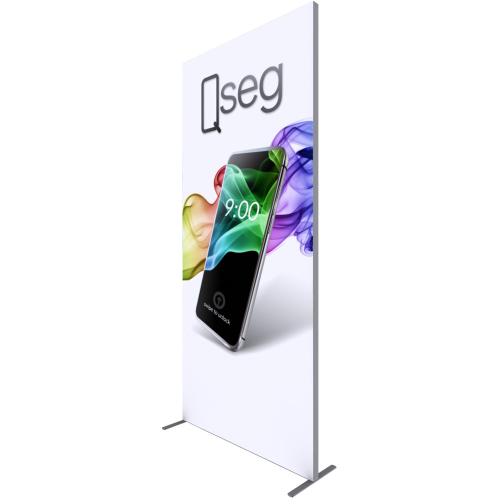
The Qseg single frame backwall is the entry point -- a single fabric wall designed to anchor a compact inline booth. It is straightforward to order, straightforward to set up, and gives you the full benefit of the SEG graphic format at the smallest scale.
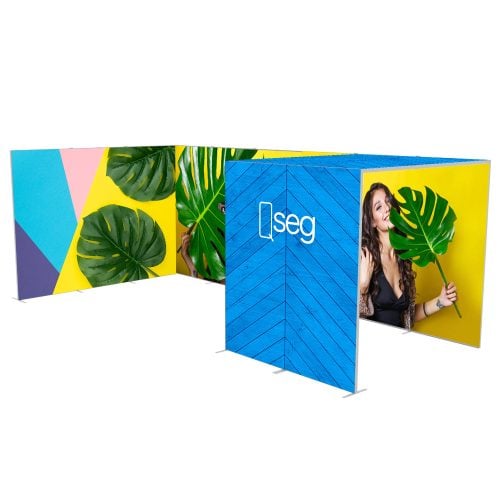
A 10x10 qseg display built around the tradeshow configuration gives you more visual real estate and optional modular extensions. The qseg trade show booth configuration supports more complex layouts: corner setups, L-shapes, and multi-panel runs that can fill a 10x20 qseg display footprint when connected.
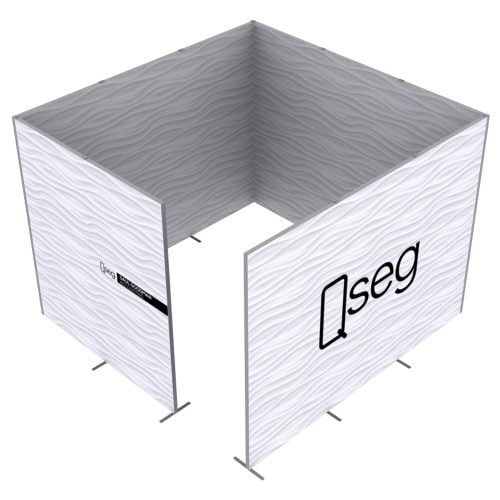
The third branch of the system -- Qseg partitions -- steps outside the traditional booth wall use case entirely. These modular panels work as room dividers, queue barriers, and office space dividers, using the same fabric-and-extrusion logic in a format designed for freestanding indoor partition applications.
A few practical decisions will shape which Qseg option makes sense and how you should specify your order.
Graphic count and change frequency. If you plan to swap graphics frequently, order an extra set at the same time your first set prints -- per-unit graphic cost decreases when printing in quantity, and having a backup set prevents downtime if a graphic is damaged. Knowing your qseg modular price per graphic panel in advance also helps you budget accurately for future campaigns.
Hardware-only versus graphic-inclusive packages. Some buyers purchase hardware first and plan graphics separately. Others want a complete qseg modular kit including frame, graphic, carry bag, and all hardware in a single order. Clarify this before finalizing your quote so you are comparing apples to apples between vendors.
Footprint and connectivity. If there is any chance you will need to expand from a 10x10 to a 10x20 in a future show cycle, confirm that your frame sections are compatible before ordering. The Qseg system is designed with this expansion in mind, but verifying the connection spec upfront avoids a frustrating mismatch later.
Show-floor logistics. Factor in how you are getting the display to the venue. SEG systems in soft cases qualify for exhibitor-carry-in at many shows, bypassing drayage entirely. That logistical advantage is worth confirming with your show organizer before you commit to a format.
Before finalizing any purchase, the modular display buying guide covers the broader decision framework -- frame types, graphic specs, drayage considerations, and how modular systems compare to custom builds -- and is worth reading if you are still in the research phase. For a wider view of exhibit formats beyond the modular category, the complete trade show displays buyer's guide provides useful context on when modular is the right call versus other display types.
Within the Showfire modular line, the Qseg system occupies the fabric SEG niche. If your preference runs toward curved geometry, the Wave Tube modular display builds organic arched shapes using a tube-frame system that accepts fabric graphics in a different profile. If you want a snap-together tube frame with a faster learning curve, the EZ Connect modular display is worth a look for its tool-free, component-based assembly.
The qseg seg modular format is specifically optimized for flat or gently angled wall surfaces -- the type that dominate inline booths and backwall configurations. It is not the right format for dramatic curves or island footprints, but for what it is designed to do, the tension graphic result is among the cleanest in the modular category.
If you want a comprehensive side-by-side view of all modular formats available, the 10x20 modular display overview page covers the full system lineup with enough detail to narrow your options before requesting a quote.
The qseg modular display is a well-documented, consistently reliable system for exhibitors who want seamless fabric graphics in a package that travels light, sets up fast, and adapts as their show schedule grows. Start by choosing your configuration -- qseg single panel for a clean standalone backwall, qseg tradeshow display for a full multi-panel booth wall, or qseg partition wall for division and space management applications.
Contact Showfire Displays for a free quote, or browse the full line to compare sizes, graphic options, and package pricing. The right configuration is closer than you think.