Need Assitance?
Call us at 844-203-6588.
We Accept

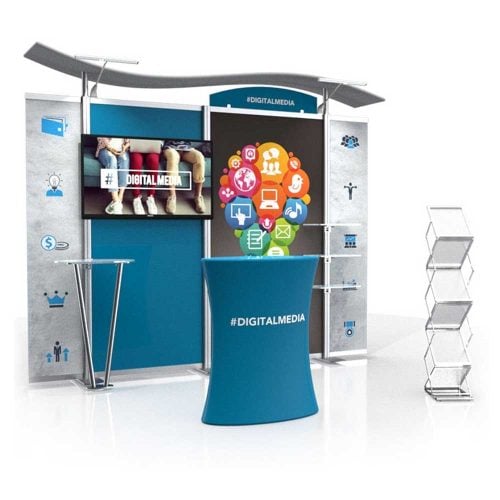
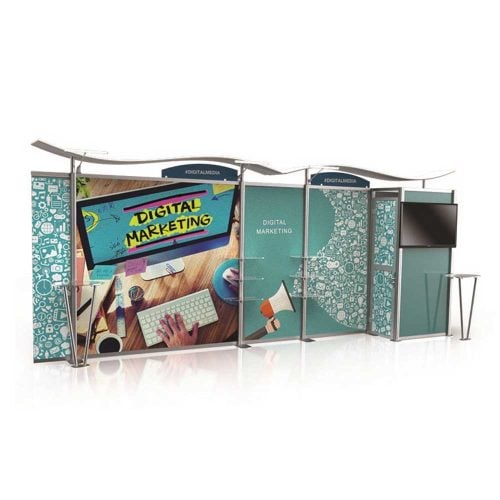
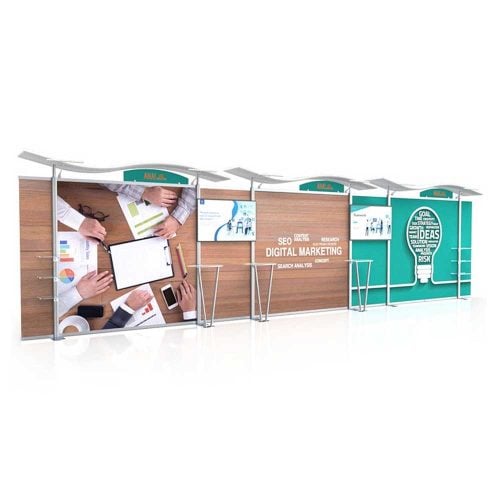
The Timberline modular display is built for exhibitors who want more structure than a fabric backwall but more flexibility than a fully custom build. Unlike tension-fabric systems that rely entirely on printed graphics to create visual depth, Timberline uses a rigid aluminum frame with hard panels and graphic inserts -- giving you a layered, architectural booth presence that photographs well and holds its shape across dozens of shows. If you have been weighing your options across the modular trade show displays category and feel like most systems look the same from twenty feet away, Timberline is worth a closer look. It ships in three footprints -- 10ft, 20ft, and 30ft -- each designed to scale without forcing you to buy a completely new system.
Most modular displays solve one problem: getting a large graphic up fast. Timberline solves a different problem -- giving your booth a sense of physical presence. The frame uses interlocking aluminum extrusions that assemble without tools, but once locked together they create a sturdy structure with genuine dimensional depth rather than a flat wall.
That depth matters for a few reasons. First, it lets you recess shelving, monitors, and literature holders into the frame rather than bolting them onto a flat surface. Second, the layered look reads as a considered design investment to attendees walking a crowded show floor. Third, the system accommodates a timberline with storage configuration, meaning you can integrate locking cabinets and counters directly into the kit -- reducing what you have to rent from show services.
The hard-panel sections accept full-color graphic inserts that are easy to swap between shows. You are not reprinting the entire system every time a product line changes; you swap the relevant panel and the rest stays. That alone can meaningfully reduce your long-term graphics budget.
This system earns its place in the lineup for a specific kind of exhibitor. It rewards companies that show frequently, carry physical product samples, and want a booth that feels more like a branded environment than a backdrop.
It fits well when you:
It is less ideal if you are exhibiting once or twice a year from a 10ft space and want the lightest possible pack weight. For that use case, the EZ Connect modular system -- a tube-frame format that packs lighter and sets up faster -- may be a stronger fit. And if your priority is curved geometry, the Wave Tube modular display offers an organic profile that works well for lifestyle brands and experiential setups.
Timberline ships in three footprints, each meaningful in how it changes what you can do with the booth. The table below gives a practical comparison across the core buying dimensions.
| Size | Best for | Typical footprint | Key capability |
|---|---|---|---|
| 10ft | First-time exhibitors, small island upgrades | 10ft inline | Full graphic wall, optional counter |
| 20ft | Mid-size brands, product demo setups | 20ft inline or L-shape | Multiple graphic zones, integrated storage |
| 30ft | High-volume exhibitors, large-hall presences | 30ft inline or peninsula | Maximum branding surface, full storage suite |
The 10ft Timberline display is where most exhibitors start. It gives you the full Timberline structure -- rigid frame, panel graphics, optional counter -- without committing to a large footprint or a large freight bill. For many companies, this size runs two or three years before they need to expand.
The 20ft Timberline modular display is where the system shows its real personality. At twenty feet you have enough horizontal run to create distinct zones -- a demo area, a product display section, and a reception counter -- without any of them feeling cramped. Most exhibitors at this size add at least one integrated storage cabinet.
The 30ft timberline booth is a significant exhibit. At this footprint you are competing with custom builds, and Timberline holds up in that company. The extended frame allows full-height graphic towers, multiple counter configurations, and enough storage to run the booth without a storage closet behind the curtain.
Getting a timberline modular display right means thinking through a few practical questions before you configure.
Graphic strategy first. Decide early whether your graphics need to change seasonally or by event. Timberline's panel-insert system makes swapping straightforward, but you should account for panel print lead times in your show prep calendar. Budget for at least one full set of backup panels if you exhibit frequently.
Storage and counters. A timberline with storage configuration ships with locking cabinet modules that sit flush with the frame. If you plan to store valuable collateral, product samples, or personal items at the show, spec the storage into your original order -- retrofitting it later adds cost. A custom timberline display configured with storage up front is almost always less expensive than adding it as an accessory.
Freight and setup. Timberline is not the lightest system in the modular displays lineup, and that is a fair trade-off for the structure it provides. Plan for a wheeled case configuration and confirm your drayage estimate before your first show. A two-person setup crew is realistic at 20ft and above; the 10ft can be managed by one person but goes faster with two.
Timberline modular price. Pricing scales with footprint and options. The timberline modular price reflects the aluminum frame quality, the graphic insert system, and any integrated furniture -- counters, shelving, storage. If you are early in your research, the modular display buying guide covers how to evaluate modular system costs against show frequency and long-term ownership, which helps put any quote in context. For a broader look at how modular systems compare across all exhibit types, the complete trade show displays buyer's guide is worth a read before you finalize your budget.
Comparing to other systems. If you are also evaluating fabric-based options, the Qseg modular display uses silicone-edge graphics stretched over a lightweight frame -- a fundamentally different feel and a lighter pack than Timberline. It is worth seeing both side by side before committing, especially if pack weight is a constraint.
One thing that gets underappreciated about Timberline is how much creative latitude the panel system actually gives you. A custom timberline display is not just a logo printed on a flat surface -- the frame's dimensional structure means you can use graphic panels to create depth illusions, highlight specific products in recessed zones, and mix bold full-panel imagery with clean negative space across a single run.
The system supports a timberline for trade show environments where you need the booth to carry the brand without a dedicated designer standing in the space. The graphic panels do the heavy lifting so your sales team can focus on conversations rather than explaining what the brand does.
A timberline modular kit ships complete with the frame, panel components, and hardware -- typically with a carry or wheeled case -- so you are not sourcing accessories separately. Check each size configuration for exactly what is included, since storage and counter options may be add-ons rather than standard in the base kit.
If you have narrowed your decision to Timberline, the next step is picking a footprint. Start with the 10ft timberline modular display if you are working a standard 10ft inline space, the 20ft timberline exhibit for a mid-size presence with room for demos and storage, or the 30ft Timberline modular display if you are ready to build a large-format branded environment.
Each product page carries full configuration details, included components, and ordering information. If you have questions about which size fits your show schedule or how to spec the storage options, the Showfire team is available to help you build the right configuration before you order.