




Trade Show Hanging Banners
What Are Trade Show Hanging Banners and Why Do They Matter?
What Are Trade Show Hanging Banners and Why Do They Matter?
If you have ever walked a large convention floor and spotted a bold, colorful sign floating high above a crowded booth — long before you could read any of the table-level displays — you already understand the basic power of overhead signage. But if you have ever asked yourself, what are trade show hanging banners, exactly, and why does every major exhibitor seem to use them? — this article is your complete answer.

What Are Trade Show Hanging Banners, Defined

So, what are trade show hanging banners? In the simplest terms, they are large-format graphic displays suspended from the ceiling rigging of a convention center or expo hall, positioned directly above an exhibitor’s booth space. Unlike floor-level signs, hanging banners operate at heights of 15′ to 30′ or more, making them visible from across a crowded hall.
They come in a wide range of shapes — squares, circles, triangles, swoops, and custom silhouettes — and are almost always printed on lightweight fabric stretched over an aluminum frame. The frame and fabric are engineered to be packed into a carry bag, shipped to the show, and assembled without heavy tools or a large crew.
Because they hang overhead rather than compete for precious floor space, they add massive visual impact without eating into the square footage you need for product displays, staff, and foot traffic. That balance between size and practicality is what makes them a staple of serious exhibitors.
To get the full strategic picture of how hanging banners fit into a complete booth build, the trade show displays buyer guide is an excellent starting point before you dive deeper into any single display type.
A Hanging Banners for Trade Shows Overview: Shapes, Sizes, and Materials
Understanding the options available is the first step toward choosing the right display. Here is a quick reference for the most common hanging banner configurations:
| Shape | Common Sizes | Best Use Case |
|---|---|---|
| Square / Rectangle | 8′ x 8′ to 20′ x 20′ | Brand name, logo, and tagline |
| Circle / Round | 6′ to 16′ diameter | Logo-centric, lifestyle imagery |
| Triangle | 6′ to 12′ per side | Corner booths, directional signage |
| Star / Burst | 8′ to 14′ wingspan | Product launches, promotional events |
| Custom Silhouette | Varies | Brand-specific shapes, die-cut looks |
Fabric is by far the dominant material. Stretch knit polyester — the same material used in the tension fabric display category — is popular because it is lightweight, wrinkle-resistant, and accepts vivid dye-sublimation printing. The graphic sleeve slips over the frame and pulls tight, eliminating creases and producing a clean, professional finish with virtually no setup effort.
Frame hardware is typically aircraft-grade aluminum tubing that snaps or twists together without tools. The finished structure is light enough that two people can assemble most standard shapes in under 30 minutes.
Why Do Trade Show Booths Use Hanging Banners?

The short answer: visibility. The longer answer involves several layered strategic benefits.
Aisle-level competition is brutal. On a show floor packed with hundreds of exhibitors, your 10′ x 10′ booth backdrop competes with dozens of neighboring displays at eye level. A hanging banner lifts your brand identity above the visual noise, making it discoverable the moment an attendee enters the hall — not just when they are standing directly in front of your table.
They anchor wayfinding. Attendees use overhead signage as landmarks to navigate large venues. When your logo hangs at 20′, you become a reference point on the mental map of everyone in the room. That translates to more intentional walk-ins from people who spotted your brand from a distance and decided to seek you out.
They reinforce brand presence. A hanging banner tells an implicit story: this company invested in being seen. That perception of seriousness and scale matters enormously in first impressions, especially at competitive industry shows.
They work in combination with floor displays. Hanging banners are not a replacement for ground-level graphics — they are a multiplier. An overhead sign driving foot traffic, a fabric pop up display providing your back wall, and a branded table cover pulling the look together create a layered brand environment that feels intentional and polished.
They are reusable. A quality hanging banner built on a durable aluminum frame with a fade-resistant fabric graphic can travel to dozens of shows. When your brand refreshes, you simply reprint the graphic sleeve — the hardware stays the same.
How Do Hanging Banners Help at Trade Shows: Practical Strategy
How do hanging banners help at trade shows in measurable, day-to-day ways? Here are the four most direct impacts:
1. Increased booth traffic. Studies and exhibitor surveys consistently show that overhead signage boosts unaided booth discovery — meaning attendees find you without consulting the show directory — by a significant margin compared to booths with only floor-level displays.
2. Faster brand recall. When attendees leave a show and try to remember where they saw your product, a distinctive overhead shape or color scheme is far more memorable than a backdrop they saw for three seconds while walking past.
3. More qualified conversations. Because hanging banners attract visitors who recognized your brand from across the hall, the people who arrive at your booth already have context. Those conversations tend to start at a higher level of interest.
4. Efficient use of booth square footage. By moving your primary brand message overhead, you free up floor and wall space for product demos, literature, and engagement activations. That is a significant operational advantage in a 10′ x 10′ or 10′ x 20′ space.
Pair your hanging banner strategy with thoughtful below-the-sign choices. Exhibitors at larger shows often combine overhead signage with a modular display system for maximum flexibility — the modular components reconfigure to fit different booth footprints from show to show while the hanging banner keeps the overhead branding consistent.
What Makes Hanging Banners Effective at Trade Shows
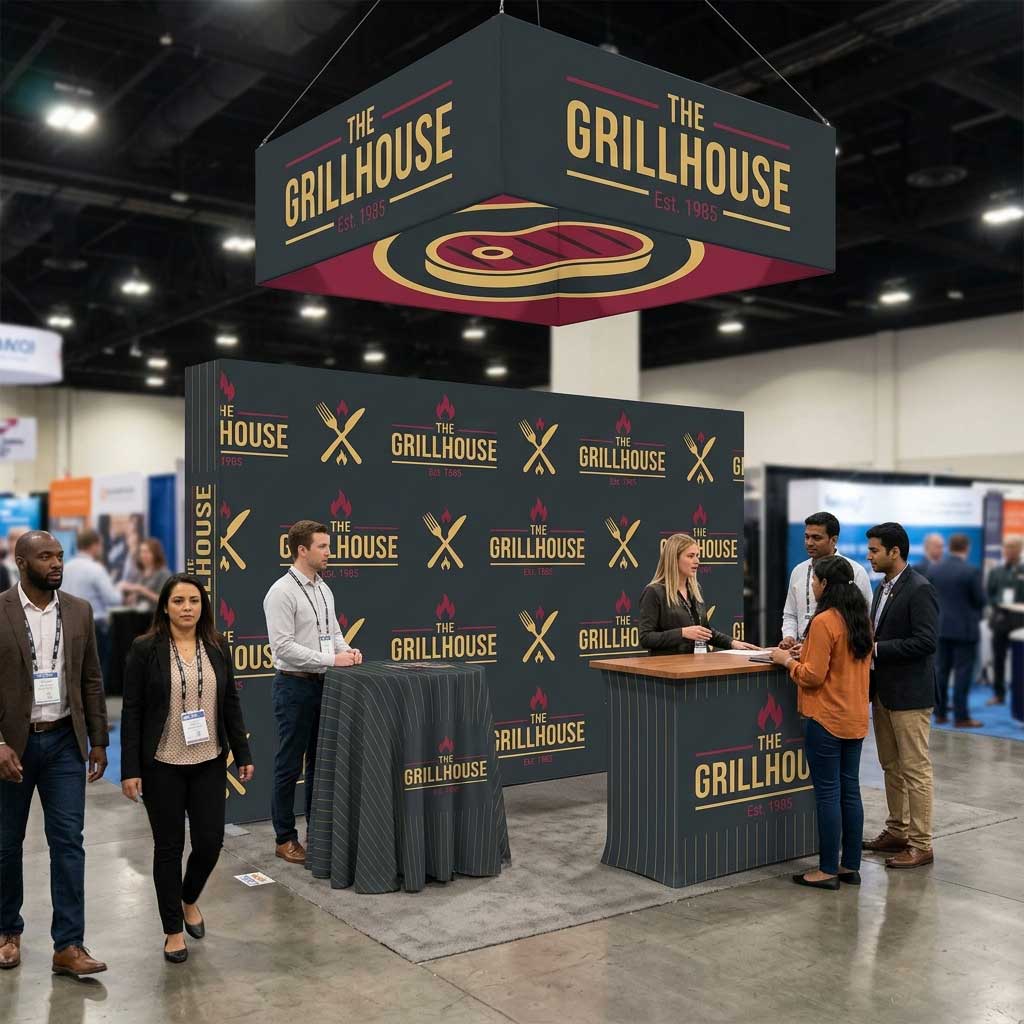
What makes hanging banners effective at trade shows comes down to three compounding factors: height, size, and simplicity. Height puts your brand above the visual clutter. Size ensures the message reads clearly from 50′ to 100′ away. Simplicity — a logo, a tagline, maybe a single bold image — means the message lands in under two seconds of glance time.
Contrast that with banners that try to communicate too much. A hanging display crammed with bullet points, pricing, and fine print fails at the one job it exists to do: get attention from a distance. The most effective hanging banners treat the overhead space like a billboard — one big idea, executed boldly.
It is also worth understanding what is the purpose of a hanging banner at a trade show relative to other vertical display formats. A tower display and a trade show truss system both pursue verticality, but through different mechanics. Truss systems are modular structural grids that hang lights, monitors, and signage from a freestanding or ceiling-hung frame — ideal for large island booths with theatrical production value. Tower displays are freestanding pillars that rise from the floor. Hanging banners, by contrast, require venue ceiling rigging points and are suspended entirely overhead — the lightest, simplest solution for achieving genuine overhead presence.
For exhibitors planning outdoor events, a branded canopy tent serves a parallel function — putting your brand high and visible — but in an environment where ceiling rigging is not available.
Choosing Between Hanging Banners and Related Display Types
Not every show permits ceiling-hung displays. Before ordering, confirm with your show management that rigging points are available and what the weight limits and fire-code restrictions are. If ceiling rigging is not an option, a retractable banner stand or a floor-mounted tower display stand can provide vertical height without the need for overhead attachment — though neither achieves the same crowd-wide visibility.
For photography or media coverage at your booth, a step and repeat banner creates a repeating logo backdrop at standing height — a completely different use case than overhead identification, but a smart complement in booths where press or social media presence matters.
And if your booth includes a presentation or demo table, a well-branded custom table throw ties the floor-level look to the overhead banner, creating visual cohesion from top to bottom.
Ready to Go Overhead?

Now that you know what are trade show hanging banners, how they work, and why exhibitors at every level rely on them, the next step is finding the right configuration for your specific booth and show. Our full Trade Show Hanging Banner Guide covers shape selection, sizing, hardware options, rigging requirements, and printing specs in detail — everything you need to make a confident buying decision.
When you are ready to browse options or get a quote, visit our hanging signs collection to explore shapes, sizes, and custom configurations available to order. And if you want to round out your complete booth strategy, the ultimate guide to trade show marketing is a strong companion resource for turning great displays into measurable lead generation results.
