Need Assitance?
Call us at 844-203-6588.
We Accept





$7,300.00

Production Time: 2 Business Days After Proof Approval
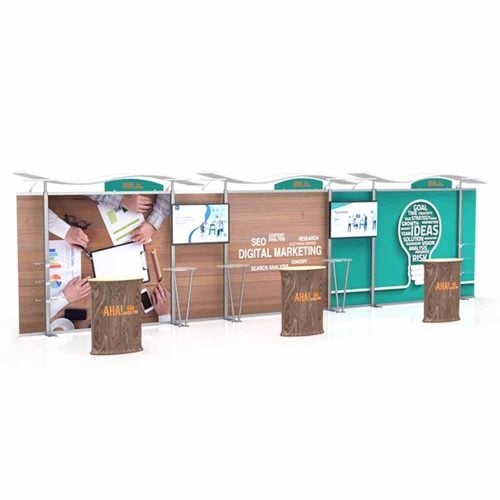
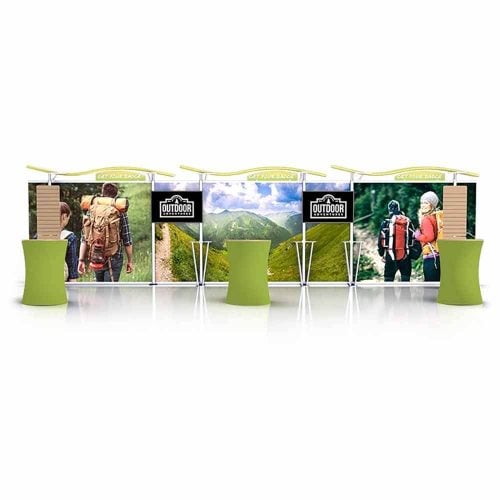
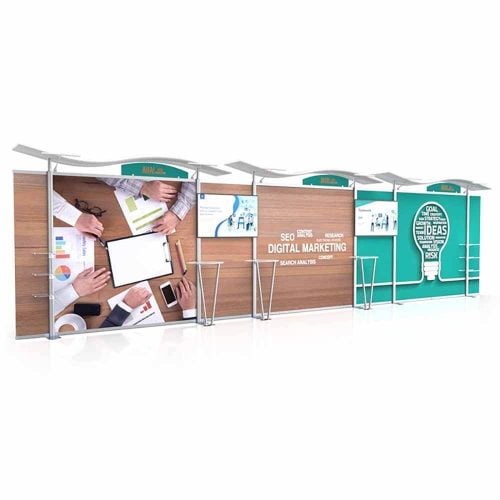
The 30ft timberline wave top display straight sides configuration gives large-format exhibitors a clean, architectural backdrop that fills a 30′ inline space without visual chaos. Its defining feature is the gently cresting wave roofline, which draws attention upward and creates a sense of height even in busy exhibition halls where competing booths are jostling for focus. Straight side panels keep the silhouette crisp and the branding real estate maximized — no angled cuts eating into your graphic area. Dye-sublimated fabric graphics are printed to the full surface of each panel, delivering sharp color reproduction that reads clearly at distance and holds up through dozens of show cycles. The kit ships in rolling cases engineered for air and ground freight, so travel between events stays organized and damage-free. Assembly uses the Timberline(R) tool-free connector system, meaning a two-person crew can raise this entire structure in roughly an hour with no hardware required. If you’re evaluating the full range of 30′ configurations, the 30ft Timberline display hub page is the right place to compare every available option side by side.
This package includes:
Product Information
| Product Information | |
| Booth Dimensions | 96″h x 359″w x 20″d |
| Acrylic Table Dimensions | 36” h x 24”w x 16”d |
| Acrylic Shelf Dimensions | 18.75″w x 9.5″d |
| Shipping Dimensions of Each Case | 27.5″w x 48″h x13.5″d |
| Number of Cases | 3 |
| Weight of Each Case | 123 |
| Total Display Weight | 369 lbs |
Many exhibitors arrive at a 30′ inline booth having outgrown a smaller presence. The problem is rarely space — it’s that standard banner walls and pop-up frames simply don’t project authority at this scale. Flat, low-profile structures look undersized against the footprint they’re supposed to anchor, and generic configurations make it difficult to establish a coherent brand environment across the full width of the booth. There’s also a practical issue: large modular kits that require specialized tools or lengthy instruction manuals put unnecessary pressure on the setup crew on a Wednesday morning before doors open.
The 30ft timberline wave top display straight sides was designed with exactly these friction points in mind. The wave-profile header rises above neighboring inline displays to define the booth’s vertical territory, while the straight side architecture keeps the overall footprint predictable and easy to work within from a floor-plan perspective.
The Timberline(R) frame system uses interlocking aluminum extrusions with integrated push-fit connectors. Each section clicks together in a fixed sequence that doesn’t require you to carry a bag of hardware or a drill. The 30ft modular display footprint is supported by a series of vertical uprights and horizontal crossbars that distribute load evenly, preventing the frame sag that plagues lighter-duty systems after repeated assembly cycles.
Fabric graphics are produced via high-resolution dye sublimation, which embeds pigment directly into the polyester weave rather than printing on top of it. The result is a panel that resists fading, wrinkling, and surface abrasion across a long show season. Straight side panels on this kit provide an unbroken rectangular graphic field — full bleed, no tapered cutouts interrupting the design layout. Designers typically prefer this configuration because it accommodates lifestyle photography, large product imagery, and brand headline text without awkward compositional adjustments.
Here’s a quick breakdown of key structural and print specs:
| Specification | Detail |
|---|---|
| Booth footprint | 30′ wide inline |
| Side panel profile | Straight (no taper) |
| Header profile | Wave top |
| Frame material | Aluminum extrusion |
| Hardware required for assembly | None |
| Graphic production method | Dye-sublimation fabric |
| Typical assembly time | 60 — 90 minutes (2-person crew) |
| Transport cases | Rolling freight cases included |
The Timberline modular display collection applies the same frame and fabric standards across every size in the lineup, which matters if you plan to mix and match components across different booth footprints in the future.
Straight side panels maximize the usable graphic surface area compared to tapered configurations. If your booth design relies on wide horizontal bands of color or text, the rectangular geometry of this configuration is significantly easier to work with.
At 30′, the wave header becomes a genuine architectural feature rather than a cosmetic accent. The crest gives the booth a distinct silhouette from across the hall floor, reinforcing brand recall even after attendees have moved on to other areas.
The rolling cases included with this kit are sized specifically for the 30ft timberline wave top display straight sides components. Packing is consistent show to show, which means less time fumbling with cases at the end of a long event day. If your program also includes regional shows where a smaller footprint makes more sense, the 20ft Timberline modular display is built on the same connector system and shares compatible components.
A custom 30ft timberline display of this scale is rarely an organization’s only exhibit asset. Most brands running a 30′ inline at major shows also maintain a smaller configuration for regional events and roadshows. The 10ft Timberline exhibit is a practical companion choice — it travels more easily, sets up faster, and shares the same fabric graphic production process, so brand consistency across booth sizes is straightforward to maintain.
If you’re still working through the broader question of which display format fits your overall trade show strategy, the modular display buying guide covers the full decision framework, including how to evaluate footprint sizes, graphic update costs, and total cost of ownership across multi-year programs.
For buyers specifically evaluating a 30ft timberline exhibit versus custom-fabricated alternatives, the Timberline system has a clear advantage in reconfigurability. Because the aluminum frame ships separately from the fabric, you can refresh graphics seasonally without replacing any structural components. A 30ft timberline with storage options can also be factored into the configuration at the design stage, adding functional back-of-booth space without requiring a separate rental structure.
The 30ft timberline wave top display straight sides is a well-defined, production-ready configuration — not a custom fabrication project with a three-month lead time. Showfire Displays works with you to finalize graphic files, confirm booth dimensions, and schedule production so your kit arrives before your first show date with time to spare. Contact the team at Showfire Displays or visit the product page directly to select your configuration, upload artwork, and get a confirmed ship date on the calendar.
| Weight | 369 lbs |
|---|---|
| Dimensions | 28 × 48 × 14 in |
Products You May Also Like

Clogo 144 Airsquirrels

Clogo 231 Baytek

Clogo 232 Treemendous

Clogo 239 Freightwaves

Clogo 234 Hardyproair

Clogo 237 Redbull

Clogo 241 Animeusa

Clogo 230 Edgefactory

Clogo 236 Fujifilm

Clogo 63 Sclhealth

Clogo 251 Ivanzi

Clogo 242 Wescom

Clogo 250 Snapcab

Clogo 225 United Teleports

Clogo 219 Ecp

Clogo 218 Baylor

Clogo 243 Lord

Clogo 175 Tamucc

Clogo 224 Becker

Clogo 212 Bankofmarin

Clogo 199 Carpetsplus

Clogo 202 Arbor

Clogo 188 Jbhunt

Clogo 197 Meteor

Clogo 193 Randc

Clogo 183 Intuit

Clogo 184 K2 Spas

Clogo 185 Unl

Clogo 187 Cirquedesoleil

Clogo 178 Petra

Clogo 173 Freedom

Clogo 161 Universalorlando

Clogo 159 Paynewest
Clogo 158 Tyson

Clogo 167 Vantage

Clogo 180 Nlp
Clogo 155 Wrs

Clogo 152 Mir

Clogo 151 Vegalab

Clogo 146 Goldfishcons

Clogo 145 Arrowavi

Clogo 156 Frg

Clogo 120 Pga

Clogo 110 Ozark

Clogo 108 Main Even
Clogo 104 Waco

Clogo 91 Seattlepump

Clogo 111 Thechapel

Clogo 134 Bakenjoy

Clogo 133 Act

Clogo 142 Cfn

Clogo 140 Hydrofarm

Clogo 126 Aerofarms

Clogo 135 Scbc

Clogo 137 Ferrumcity

Clogo 94 Miyokos

Clogo 93 Landaw

Clogo 98 Renttruck

Clogo 100 Cpmontana

Clogo 85 Hulu

Clogo 87 Schomp
Clogo 88 Beefjerky

Clogo 103 Amature

Clogo 81 Gartner
Clogo 80 Betson

Clogo 75 Blades

Clogo 73 Roseland

Clogo 72 Vacumax

Clogo 65 Nationwide
Clogo 45 Holanamericaline

Clogo 44 Livenation

Clogo 37 Mobilefleet

Clogo 56 Corporater
Clogo 55 Nextstar
Clogo 36 Oro

Clogo 34 Corecontractors

Clogo 54 Tazikis

Clogo 46 Kbellaspa

Clogo 204 Congoleum

Clogo 32 Veoride
Clogo 33 Bigiron

Clogo 30 Nutrabolt

Clogo 17 Foodmaven

Clogo 24 Comcast

Clogo 21 Radiantcurch

Clogo 05 Nikaochurch

Clogo 28 Bindlecoffee

Clogo 83

Clogo 246 Cstechnologies

Clogo 247 Gainesville

Clogo 52 Godlan

Clogo 08 Theheightschurch

Clogo 12 Go By Greenshield Oragnic

Clogo 14 Backbeat Creative