Need Assitance?
Call us at 844-203-6588.
We Accept

A 30ft booth space is a serious commitment -- in floor fees, in setup time, and in the brand impression you need to generate to justify every square foot. Exhibitors who reach for this footprint have usually outgrown the standard backwall and need a structure that can carry multiple branding zones, handle live product interaction, and work as a functional workspace rather than a flat backdrop. The 30ft timberline display answers that brief with a frame-based architecture that organizes your space vertically and horizontally, introduces visual interest through its wave-top profile, and builds in practical features -- slat walls, monitor mounting, storage -- that smaller configurations simply cannot accommodate. This page covers what makes the 30ft format the flagship of the Timberline line, who it serves best, and what to think through before you configure one.
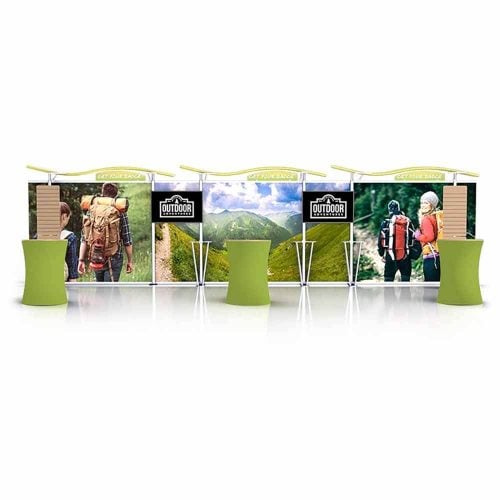
Most exhibitors scale up by buying a bigger graphic -- a 20ft backwall stretched to 30ft. The result is more fabric but not more structure. The 30ft timberline display takes a different approach: the frame itself does architectural work, creating visual breaks, defined zones, and a three-dimensional profile that changes how visitors read the booth from across the aisle.
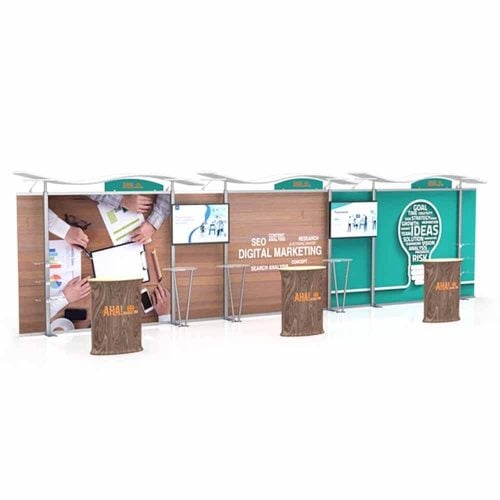
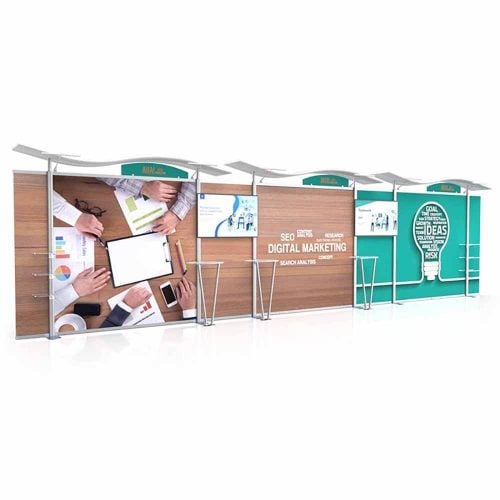
The wave-top silhouette is the most visible element. Instead of a flat horizontal line across the top of your booth, the frame rises and dips in a controlled curve, differentiating your display from the flat-panel neighbors on either side. Tapered sides add to the effect, giving the exhibit a shaped footprint rather than a rectangular block.
Behind the graphics, slat wall sections create a functional vertical surface for hanging accessories -- product hooks, literature pockets, shelving brackets -- without requiring secondary furniture that eats into floor space. This combination of shape and function is what separates the 30ft timberline exhibit from a simple backwall at the same width.
For the full context on how the Timberline family is engineered across all three sizes, the Timberline modular display parent page covers framework options, graphic systems, and the shared architecture that runs through every configuration.
Not every exhibitor needs -- or can effectively use -- 30 linear feet of modular display. This footprint is best suited to companies that match several of the following conditions.
You exhibit in the same booth repeatedly. The Timberline frame ships in cases and reassembles cleanly from show to show, which means the per-show amortized cost drops significantly over a multi-year exhibit calendar. If you do three or more major shows per year, the investment calculus shifts in your favor quickly.
You sell through demonstration or consultation. The slat wall system and internal storage turn the back half of a 30ft space into a working area. Staff can pull product from organized storage, demo on a mounted monitor, and manage back-of-booth materials without a visible clutter problem.
You need clear brand segmentation across a single booth. A 30ft modular display lets you run distinct graphic panels for different product lines, services, or audience segments within one continuous structure. The frame's geometry helps the eye read those zones as intentional rather than random.
You share booth space between business units or partners. The tapered sides and defined frame sections make it practical to assign each panel or slat wall section to a different stakeholder without the display looking like a patchwork.
If you are earlier in the scaling process, the 20ft timberline exhibit covers a mid-range footprint that delivers similar architecture with fewer cases and a lower setup overhead -- a reasonable benchmark to compare against before committing to 30ft.
Before you configure a 30ft timberline booth, there are several practical variables worth working through carefully. Getting these right on paper before you order saves time, reprints, and setup complications on the show floor.
At 30ft, the graphic surface area is substantial. The wave-top profile and tapered sides mean some panels are shaped rather than rectangular, which affects how your artwork is laid out. Confirm with your designer that the template accounts for the full panel geometry, not just a flat 30ft x standard height frame. Shaped panels require vector art built to the correct bleed and panel-edge tolerances.
If your brand uses a photographic panorama or a continuous environmental image, make sure the print vendor tiles and registers the panels so seams land in visually neutral areas -- not across a face or a headline.
The 30ft timberline wave top monitor display tapered sides package is designed to incorporate screen mounting within the frame structure. Before selecting a monitor size, confirm that the mount position works with your planned aisle approach angle. A monitor positioned for head-on viewing may be partially obscured from the side aisles at a corner booth.
The 30ft timberline with storage option uses enclosed rear sections accessible to staff during the show. Think through what actually goes in that storage during show hours -- product inventory, personal items, A/V equipment -- and configure the door placement and shelf height accordingly. Storage configured for brochures requires different interior dimensions than storage configured for demo hardware.
A 30ft structured frame takes longer to assemble than a fabric pop-up of the same width. Plan for a two-person setup crew at minimum, and build a realistic setup window into your show schedule. Many exhibitors configure a dry run at their facility before the first show to identify any fit issues, practice the assembly sequence, and confirm that all hardware is accounted for.
The 30ft timberline wave top display tapered sides with slat walls ships in multiple cases. Know your case count before show day and confirm that your freight carrier and drayage contractor are aligned on the delivery details. Undersized freight estimates at large conventions can result in unexpected drayage overage charges.
For a broader framework on freight, setup logistics, and how to evaluate a modular system before you buy, the modular display buying guide covers these factors systematically.
| Factor | 10ft | 20ft | 30ft |
|---|---|---|---|
| Booth footprint | Inline 10ft | Inline 20ft | Inline 30ft |
| Wave-top profile | Yes | Yes | Yes |
| Slat wall option | Limited | Partial | Full |
| Monitor mounting | Optional | Yes | Yes |
| Rear storage | Optional | Optional | Configured |
| Typical case count | Lower | Moderate | Higher |
| Ideal show frequency | Occasional | Regular | Frequent |
If you are evaluating how the 30ft configuration compares at the smaller end of the range, the 10ft Timberline modular display is worth reviewing -- it uses the same core frame language at a scale suited to single-day events or secondary shows where you want visual consistency with a smaller logistics footprint.
The 30ft footprint is where the Timberline system delivers its full range of features. At this size, the wave-top silhouette, slat wall functionality, monitor integration, and rear storage all work together rather than as isolated add-ons. That coherence is the strongest argument for the 30ft timberline display over a flat-panel alternative of the same width.
The 30ft format also performs best when it is part of a multi-show exhibit strategy rather than a one-off event purchase. If your company exhibits at regional shows with smaller footprints, the 20ft timberline modular can complement the 30ft configuration -- sharing graphic language and structural components across both display sizes reduces your design and fabrication overhead over time.
For exhibitors who are newer to structured modular systems generally, the trade show displays buyer guide provides a solid orientation to how different display categories compare, what to budget for printing and logistics, and how to evaluate vendors before committing.
The 30ft timberline display is built for exhibitors who are ready to make a booth work harder -- as a brand surface, a product demo environment, and a functional backstage workspace, all within a single coherent structure. If your show schedule and booth goals support a 30ft commitment, this configuration delivers the Timberline system at its most complete.
Ready to spec your exhibit? Contact the Showfire Displays team to walk through configuration options, graphic specifications, and lead time for your next show. Start your inquiry today at showfiredisplays.com and get your custom timberline display dialed in before your next deadline.