




Trade Show Marketing Strategies
Trade Show Booth Staff Training: How to Prepare Your Team
Your booth display looks incredible, your giveaways are packed, and your travel itinerary is set — but have you prepared the people who will actually win (or lose) business on the show floor? Trade show booth staff training is one of the most overlooked investments exhibitors make, yet it has a bigger impact on ROI than almost any other pre-show decision. This guide gives you a practical, step-by-step framework for getting your team show-ready before the doors open.

Why Trade Show Booth Staff Training Matters More Than You Think
A stunning exhibit can draw people in, but it takes a confident, well-prepared person to turn a curious passerby into a qualified lead. Studies consistently show that booth staff behavior — not display aesthetics — is the top reason attendees choose to stop, engage, or walk away.
Poor booth etiquette is shockingly common. Staff eating at the booth, staring at phones, huddling in conversation with each other, or launching into an unprompted product monologue all destroy first impressions instantly. Structured trade show booth staff training eliminates these habits before they cost you real opportunities.
If you are still building out your exhibit strategy from scratch, the complete trade show displays buyer’s guide covers display formats, budgeting, and everything else you need to make informed purchasing decisions before you focus on staffing.
Pre-Show Preparation: Building the Foundation
Set Clear Goals Before Training Begins
Training without a target is just a pep talk. Before you walk your team through any talking points, define:
- The specific lead volume target for the show
- The qualification criteria for a “good” lead
- The one or two core messages staff should communicate in every conversation
- The call to action you want every visitor to leave with
Once these are in place, every other element of your trade show booth staff training can be tied back to measurable outcomes your team actually cares about.
Know Your Audience Before You Know Your Pitch
Different shows attract different buyer personas. A B2B manufacturing expo draws engineers and procurement managers; a consumer lifestyle show draws enthusiastic early adopters. Your team needs to understand who they are speaking to, what problems those people need solved, and how your product or service answers those problems in plain language.
Role-playing common attendee objections is one of the highest-value exercises you can run. Pair staff up and have them take turns playing skeptical visitors. This builds confidence, exposes gaps in product knowledge, and makes real conversations feel familiar rather than stressful.
Core Trade Show Booth Staff Tips for Working the Floor

The difference between a good booth staffer and a great one comes down to a handful of repeatable behaviors. Use the checklist below as a training reference in the days leading up to the show.
| Behavior | Why It Matters |
|---|---|
| Smile and make eye contact | Opens the door for natural conversation |
| Stand, don’t sit | Projects energy and approachability |
| Open with a question, not a pitch | Qualifies interest before investing time |
| Listen actively before presenting | Builds rapport and uncovers real pain points |
| Keep phones out of sight | Signals full attention to every visitor |
| Tag-team handoffs between staff | Keeps energy fresh and covers more ground |
| Log lead notes immediately | Prevents memory gaps during follow-up |
These trade show booth staff tips apply whether you are working a compact 10′ x 10′ inline space or a sprawling island exhibit. The fundamentals of human connection do not change with square footage.
When your booth design is visually strong, it gives your staff a natural conversation starter — something in the environment that visitors comment on. If you need inspiration for your physical space, the guide on trade show booth ideas covers 25 proven concepts that make a booth more engaging for both staff and attendees.
Running Effective Training Sessions
The 60-Second Pitch Drill
Every staff member should be able to deliver a crisp, compelling overview of your company’s value proposition in under sixty seconds. Time them. Repeat the exercise until the delivery feels natural, not rehearsed. The goal is not memorization — it is internalization.
After the 60-second pitch, immediately practice the pivot: “What brings you to the show today?” Getting staff comfortable moving from pitch to discovery question is where most training programs fall short.
Badge Reading and Lead Qualification
Teach your team to read badge information quickly and use it as an ice-breaker. A badge might reveal that someone is a VP of Operations at a mid-size manufacturer — that context changes everything about how the conversation should open.
Establish a simple lead scoring system your team can apply on the spot. A three-tier system works well for most exhibitors:
- Hot: Decision-maker, active budget, near-term timeline
- Warm: Influencer or evaluator, exploring options within the next two quarters
- Cool: Early research phase or wrong fit — worth a brief conversation, not a long presentation
Train your team to identify tier within the first two minutes and spend time accordingly. This protects energy across a long show day and dramatically improves follow-up efficiency.
Booth Coverage and Shift Planning
Even the most enthusiastic staff members hit a wall after several hours on their feet. Build a shift rotation into your training plan so everyone knows when they are “on” versus on a break. Overlapping shifts prevent coverage gaps while giving individuals time to recharge.
Assign a “floor captain” for each shift — someone responsible for observing overall flow, stepping in when a conversation needs a closer, and making real-time adjustments if traffic patterns shift. This role is especially valuable at larger shows where booth traffic can be unpredictable.
Booth Setup, Signage, and the Staff Experience
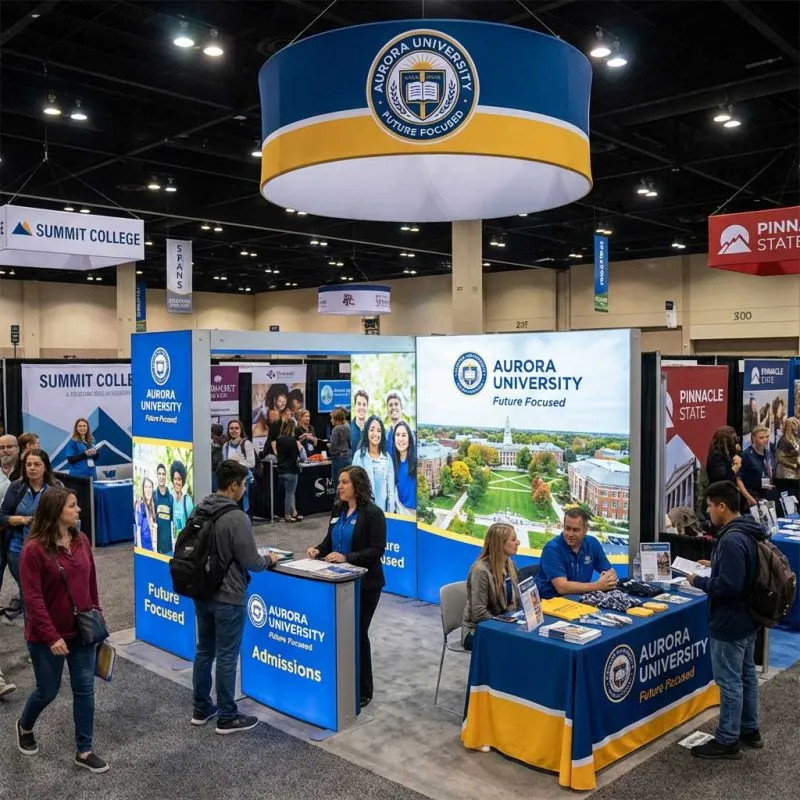
Your staff cannot perform at their best if the physical environment works against them. A well-designed booth — with clear traffic flow, visible key messages, and strategic product placement — makes every conversation easier to start and sustain.
If your team will be working in a larger format exhibit, overhead visibility is a real asset. A strong trade show hanging banner draws attendees from across the hall and orients visitors before they even reach your staff, which means your team spends less time on introductions and more time on qualifying conversations.
For exhibitors working with portable setups, understanding your backdrop options matters too. If you are weighing display formats ahead of your next show, the fabric pop up display guide breaks down material types, frame systems, and graphics considerations in detail.
The physical design of your exhibit and the training of your people should reinforce each other. A booth that visually communicates your brand story lets your staff focus on relationship-building rather than brand-explaining. If you have not finalized your exhibit layout yet, the step-by-step walkthrough on how to design a trade show booth will help you think through flow, focal points, and messaging hierarchy before you lock in any final decisions.
Post-Show Debrief: Close the Training Loop
Trade show booth staff training should not end when the show does. A structured debrief — within 48 hours while memories are fresh — turns each show into a learning asset for the next one.
Run through these questions as a team:
- Which conversation openers worked best?
- Where did we lose people’s attention?
- Were our lead qualification criteria accurate?
- What questions did attendees ask that we were not prepared to answer?
- What would we do differently with the booth layout or staffing schedule?
Document the answers and build them into your next training cycle. Over time, this feedback loop produces a team that gets measurably better from show to show.
Ready to Make Your Next Show Your Best One?
Great trade show booth staff training is a multiplier — it amplifies everything else you invest in, from your display to your giveaways to your follow-up sequence. Start training earlier than you think you need to, role-play more than feels comfortable, and debrief honestly after every event.
For a broader look at how staffing fits into your overall event strategy, the ultimate guide to trade show marketing walks through every phase of the exhibiting process in one place. Whether you are planning your first show or your fiftieth, a prepared team is always the most valuable thing you bring through those exhibit hall doors.