



Need Assitance?
Call us at 844-203-6588.
We Accept





$20,100.00

Production Time: 2 Business Days After Proof Approval
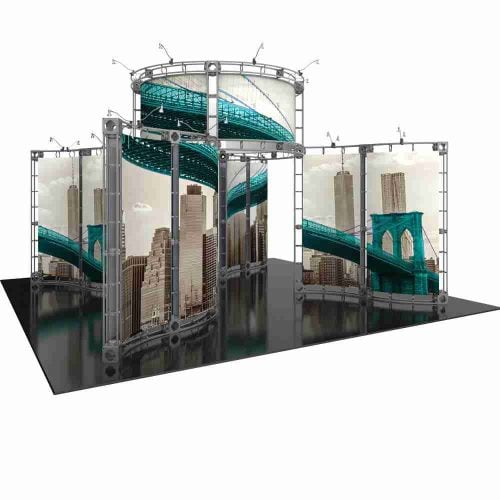
The canis 20×20 orbital truss exhibit is built for exhibitors who need a full island footprint without the complexity of a custom-fabricated booth. At 20′ x 20′, this aluminum truss structure delivers a commanding overhead presence, clean sightlines from every aisle, and enough interior space to run product displays, seating, and staff stations simultaneously. The Canis configuration ships as a modular kit, meaning your team assembles the frame without tools or specialized labor — and breaks it down just as fast at the end of a show. Graphics are produced to fit the exact frame geometry, so colors and branding sit flush and taut across every panel. Because the system is reusable, you amortize the investment across dozens of events rather than paying rental fees each cycle. The frame is lightweight aluminum, so even a large-format kit like this packs into manageable cases that clear standard freight channels. If you are sourcing a 20×20 aluminum truss display that your team can own, operate, and reconfigure without outside help, the Canis is worth a close look.
– 20′ x 20′ kit size
– Custom appearance
– Toolless assembly
– Simple twist and lock design
Kit includes:
– 28 x 6-way junction boxes
– 16 x 36″ straight truss lengths
– 12 x 46″ straight truss lengths
– 32 x 45° curved truss lengths
– 1 x full set of quicklock connectors
– 24 x Lumina 1, 50 watt spotlights
– 4 x OCF molded cases
Graphic materials: Dye sublimated fabric or UV printed panels
Not every 20×20 exhibit format suits the same exhibitor. The Canis lives in the aluminum orbital truss category, which puts it in direct comparison with rental pipe-and-drape packages and lightweight fabric pop-up systems. Understanding those differences quickly clarifies which format earns its cost.
Before the table, note that the full range of 20×20 configurations — including the Canis and its siblings — is catalogued on the 20×20 truss display category page, where you can compare frame layouts side by side.
| Criteria | Canis 20×20 Orbital Truss | Rental Pipe-and-Drape | Fabric Pop-Up System |
|---|---|---|---|
| Ownership cost over 3 years | Lower (buy once, reuse) | Higher (fees every show) | Low, but limited structure |
| Visual height and overhead impact | Strong — truss arches and connectors add vertical dimension | Minimal — flat drape walls | Low — no overhead element |
| Setup complexity | Moderate — tool-free but structured | Very low | Very low |
| Reconfigurability | High — modular sections swap in and out | Low — venue-controlled | Low — fixed frame geometry |
The rental option looks attractive up front, but the cost compounds quickly across a full show calendar. A fabric pop-up system is genuinely fast to set up, but it cannot replicate the three-dimensional overhead geometry that makes a 20×20 orbital truss booth visible from across a busy hall floor.
The canis 20×20 orbital truss exhibit is optimized for island booth placements — corners and center-floor positions where attendees approach from multiple directions. That multi-directional visibility is where the truss format earns its footprint cost most decisively: each face of the structure can carry independent branded graphics, so your messaging reads clearly whether a visitor is walking in from the north or east aisle.
Technology, medical device, and industrial equipment categories tend to get the most from this format because those exhibitors need floor space for demos and table-top hardware alongside vertical branding. The interior of a 20′ x 20′ frame also accommodates monitor mounts, hanging product, and lighting rigs that integrate directly with the truss chord — none of which require a secondary structure.
Trade show veterans who rotate through multiple shows annually appreciate that the Canis ships and stores efficiently between events. The modular aluminum sections break down into labeled cases, so inventory is straightforward and nothing disappears in a warehouse between cycles. For exhibitors who want to explore the broader family of orbital aluminum structures before committing to a 20×20 footprint, the orbital express truss category covers every available size and configuration in one place.
If your floor plan calls for a linear rather than island layout, the 10×20 truss exhibit offers the same orbital aluminum construction in a format sized for in-line booth spaces — a sensible alternative if you split your calendar between island and in-line shows.
A custom 20×20 orbital truss configuration like the Canis is only as effective as its graphic package. Fabric graphics for this system are dye-sublimation printed, which means colors are saturated and consistent across large panel widths without the banding or seam artifacts you see on vinyl alternatives. The fabric also travels well — it rolls or folds without creasing permanently, which keeps replacement cycles longer than you might expect.
Lighting mounts directly to the truss chord at any point along the frame, and the Canis geometry provides enough chord length to distribute light evenly across all four faces of the booth. LED bar lights and spotlights that clip to standard truss are compatible without modification, and the overhead structure naturally conceals power cabling from visitor sightlines.
For teams evaluating the trade show truss buying guide before finalizing a purchase, that resource covers structural load ratings, lighting compatibility, and the full decision framework for choosing between truss sizes and system types.
If you are also considering a smaller backup display for regional shows or tabletop events, the 10×10 truss exhibit uses the same orbital aluminum system at a fraction of the footprint — a practical way to extend your truss investment across show sizes.
The canis 20×20 orbital truss exhibit is a proven format for exhibitors who want an owned, reusable island structure that travels efficiently and sets up without outside contractors. At 20′ x 20′, it offers enough floor area for serious product presentations, enough vertical presence to register from across the hall, and enough graphic surface to carry a full brand story on every face.
Review the complete specification sheet, graphic upload requirements, and lead-time details on the product page, then configure the Canis for your next event. Your next show floor is already booked — make sure the hardware is ready to match it.
| Weight | 120 lbs |
|---|---|
| Dimensions | 51 × 39 × 24 in |
Products You May Also Like

Clogo 144 Airsquirrels

Clogo 231 Baytek

Clogo 232 Treemendous

Clogo 239 Freightwaves

Clogo 234 Hardyproair

Clogo 237 Redbull

Clogo 241 Animeusa

Clogo 230 Edgefactory

Clogo 236 Fujifilm

Clogo 63 Sclhealth

Clogo 251 Ivanzi

Clogo 242 Wescom

Clogo 250 Snapcab

Clogo 225 United Teleports

Clogo 219 Ecp

Clogo 218 Baylor

Clogo 243 Lord

Clogo 175 Tamucc

Clogo 224 Becker

Clogo 212 Bankofmarin

Clogo 199 Carpetsplus

Clogo 202 Arbor

Clogo 188 Jbhunt

Clogo 197 Meteor

Clogo 193 Randc

Clogo 183 Intuit

Clogo 184 K2 Spas

Clogo 185 Unl

Clogo 187 Cirquedesoleil

Clogo 178 Petra

Clogo 173 Freedom

Clogo 161 Universalorlando

Clogo 159 Paynewest
Clogo 158 Tyson

Clogo 167 Vantage

Clogo 180 Nlp
Clogo 155 Wrs

Clogo 152 Mir

Clogo 151 Vegalab

Clogo 146 Goldfishcons

Clogo 145 Arrowavi

Clogo 156 Frg

Clogo 120 Pga

Clogo 110 Ozark

Clogo 108 Main Even
Clogo 104 Waco

Clogo 91 Seattlepump

Clogo 111 Thechapel

Clogo 134 Bakenjoy

Clogo 133 Act

Clogo 142 Cfn

Clogo 140 Hydrofarm

Clogo 126 Aerofarms

Clogo 135 Scbc

Clogo 137 Ferrumcity

Clogo 94 Miyokos

Clogo 93 Landaw

Clogo 98 Renttruck

Clogo 100 Cpmontana

Clogo 85 Hulu

Clogo 87 Schomp
Clogo 88 Beefjerky

Clogo 103 Amature

Clogo 81 Gartner
Clogo 80 Betson

Clogo 75 Blades

Clogo 73 Roseland

Clogo 72 Vacumax

Clogo 65 Nationwide

Clogo 45 Holanamericaline

Clogo 44 Livenation

Clogo 37 Mobilefleet

Clogo 56 Corporater

Clogo 55 Nextstar

Clogo 36 Oro

Clogo 34 Corecontractors

Clogo 54 Tazikis

Clogo 46 Kbellaspa

Clogo 204 Congoleum

Clogo 32 Veoride

Clogo 33 Bigiron

Clogo 30 Nutrabolt
Clogo 17 Foodmaven

Clogo 24 Comcast
Clogo 21 Radiantcurch

Clogo 05 Nikaochurch
Clogo 28 Bindlecoffee
Clogo 83

Clogo 246 Cstechnologies

Clogo 247 Gainesville

Clogo 52 Godlan

Clogo 08 Theheightschurch

Clogo 12 Go By Greenshield Oragnic

Clogo 14 Backbeat Creative


