




Step and Repeat Displays
Step and Repeat Size Guide: A Chart for Every Booth Format
Choosing the right step and repeat size is one of the first decisions you make when planning a branded backdrop, and getting it wrong means wasted print budget or a display that looks cramped next to your booth neighbors. The good news is that sizing follows a short set of rules tied to your venue space, your expected crowd depth, and how many logos need to tile across the banner. This guide breaks down every common format so you can walk into your next event with confidence.
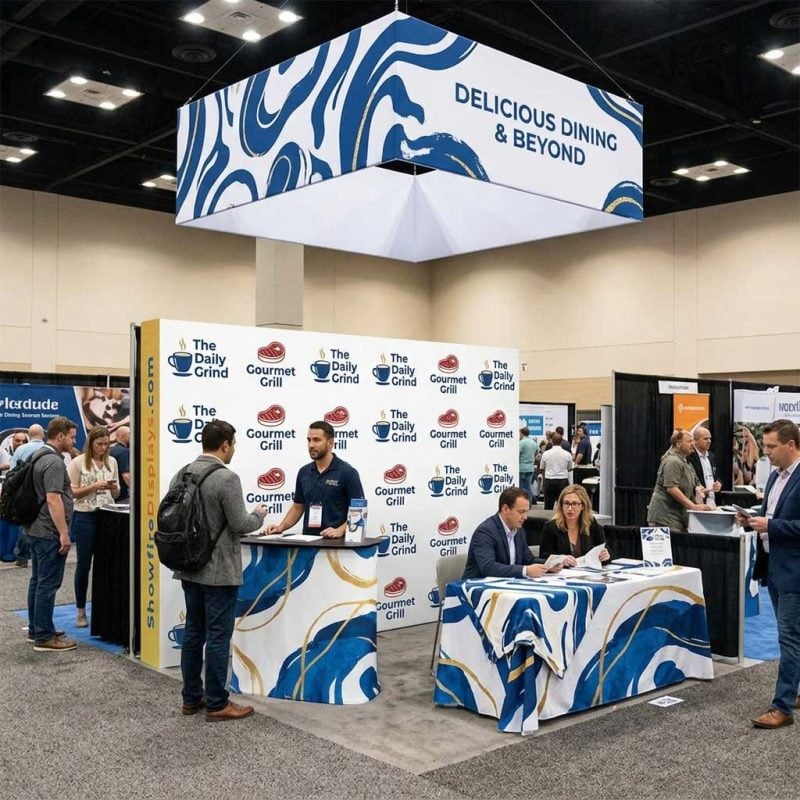
If you want the full picture on materials, hardware, and setup before diving into dimensions, our complete guide to step and repeat displays covers everything from fabric choices to frame types in one place.
Why Step and Repeat Size Matters More Than You Think
A backdrop that is too narrow will crop subjects at the shoulders in photos, defeating the whole purpose of a branded press wall. A backdrop that is too tall for a venue with a low drop ceiling becomes an installation headache on-site. And a banner sized for a 10′ x 10′ booth space will look lost in a 20′ x 20′ island exhibit.
The size of step and repeat you choose also affects how your logo pattern tiles. The goal is to have at least two full logo repetitions visible behind any subject standing at the center of the display, so a narrower backdrop demands tighter, smaller logo tiles to stay readable in photos. Following step and repeat design logo size, spacing and layout rules ensures your tile pattern reads cleanly no matter how wide the banner runs.
Step and Repeat Standard Sizes at a Glance
Most event planners and exhibit managers work from a small set of proven dimensions. These step and repeat banner sizes have become industry defaults because they fit standard venue footprints and ship on common freight carriers without special handling.
| Width | Height | Best Use Case |
|---|---|---|
| 4′ x 8′ | 48″ x 96″ | Small press events, retail activations, photo booths |
| 6′ x 8′ | 72″ x 96″ | Corporate receptions, award ceremonies, media walls |
| 8′ x 8′ | 96″ x 96″ | Standard trade show booths, 10′ x 10′ exhibit space |
| 8′ x 10′ | 96″ x 120″ | Trade show floors, conference keynote areas |
| 10′ x 8′ | 120″ x 96″ | Red carpet events, wide-format media walls |
| 10′ x 10′ | 120″ x 120″ | 10′ x 10′ island booths, premium brand activations |
| 12′ x 8′ | 144″ x 96″ | 20′ inline booths, large conference backdrops |
| 16′ x 8′ | 192″ x 96″ | 20′ x 20′ booths, grand openings, large galas |
| 20′ x 8′ | 240″ x 96″ | Oversized media walls, stadium and arena events |
Heights of 8′ and 10′ are the most common because they align with standard pipe-and-drape systems and most venue ceiling clearances. Anything above 10′ tall typically requires a custom frame and advance venue approval.
How to Choose the Right Step and Repeat Size for Your Booth
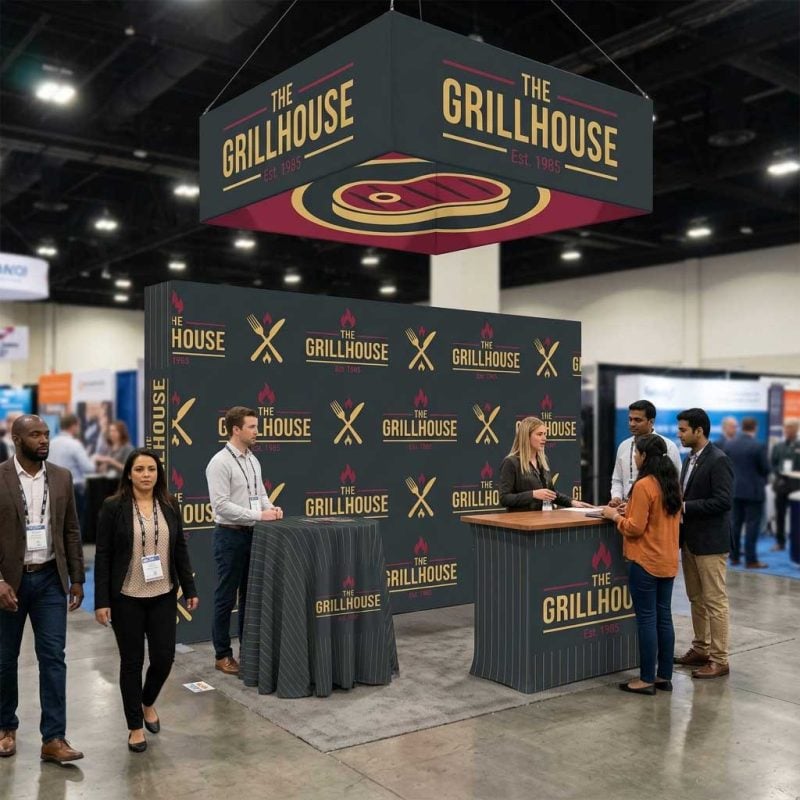
Match Width to Your Booth Footprint
The simplest rule: your backdrop should not exceed the width of your booth space, and ideally should sit 1′ to 2′ inside the boundary on each side so traffic can flow. For a 10′ x 10′ exhibit, an 8′ wide backdrop is the sweet spot. For a 20′ inline booth, a 16′ wide display fills the wall without crowding neighboring exhibits.
Account for Camera Distance
How big is a typical step and repeat often depends less on the booth and more on the photographer’s position. A camera set up 6′ to 8′ in front of the backdrop captures roughly a 6′ wide slice of the banner at portrait orientation. If you want three full logo repetitions in every shot, your tile design needs to plan for that 6′ capture zone, not just the total banner width.
Ceiling Height and Venue Constraints
Before ordering, confirm the venue’s clear ceiling height. Convention centers typically offer 14′ to 20′ of clearance, but hotel ballrooms sometimes drop to 10′ or less. A 10′ tall frame with pipe feet can push 11′ to 11.5′ in total height, which is too tall for some ballrooms. When in doubt, an 8′ tall banner is the safer call and still photographs beautifully.
Crowd Volume and Traffic Flow
For high-traffic photo opportunities at galas or charity events, a wider backdrop (12′ or 16′) keeps the line moving because two or three guests can pose simultaneously. For a focused corporate headshot station, 6′ x 8′ is plenty and takes up less valuable floor space.
Real-World Scenario: What Worked at a Mid-Size Trade Show
A marketing team exhibiting in a 10′ x 20′ inline booth at a healthcare industry conference needed a branded photo wall for a lead-capture activation. They initially spec’d a 20′ wide backdrop to fill the entire booth, but the venue’s pipe-and-drape infrastructure only left 18′ of usable wall width after post placements.
The team sized down to a 10 x 10 step and repeat positioned at one end of the booth, leaving the other half open for product demos. The 10′ x 8′ format framed attendees cleanly, fit within the 10′ half of the booth, and gave the photographer enough distance to capture two guests at a time without cropping logos. The activation drove more badge scans than any other element in the booth.
A Decision Framework: Which Step and Repeat Size Fits Your Format
Use this matrix to match your event type to the right starting dimension, then adjust based on the ceiling and camera distance factors above.
| Event Type | Recommended Width | Recommended Height | Notes |
|---|---|---|---|
| 10′ x 10′ trade show booth | 8′ | 8′ or 10′ | Leave 1′ on each side for safety |
| 10′ x 20′ inline booth | 10′ or 12′ | 8′ | Use at one end of the booth |
| 20′ x 20′ island exhibit | 16′ | 8′ or 10′ | Frame multiple guests at once |
| Hotel ballroom gala | 8′ or 10′ | 8′ | Confirm ceiling clearance first |
| Red carpet / press event | 12′ to 20′ | 8′ or 10′ | Wider = more simultaneous poses |
| Retail pop-up or photo booth | 4′ or 6′ | 8′ | Compact footprint, easy transport |
What is a good size for a step and repeat when you are unsure? Start with 8′ x 8′. It is the single most versatile format, fits nearly every venue, ships on standard carriers, and photographs well for one or two subjects. Scale up from there once you have confirmed your booth width and ceiling height.
Pairing Your Step and Repeat with Other Display Elements
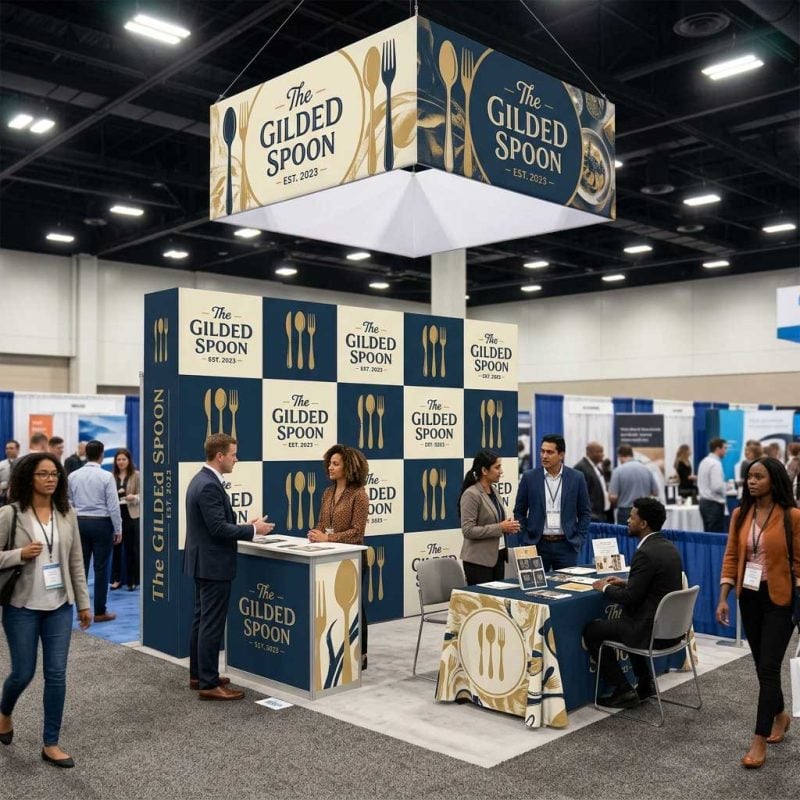
A step and repeat rarely lives alone on a show floor. If you are building out a full exhibit, consider how the backdrop interacts with overhead signage. Our trade show hanging banner guide explains how to coordinate ceiling-hung signs with ground-level displays so your brand reads consistently from across the hall without competing visually with your photo wall.
For booths that also need a portable presentation wall beyond the branded backdrop, our fabric pop up display buying guide walks through how curved and straight pop-up frames compare to step and repeat frames in terms of footprint, setup time, and graphic changeability.
If you are approaching trade shows as a first-time exhibitor and want to understand where a step and repeat fits in the broader display mix, the trade show displays buyer guide is the right place to start before you finalize any individual piece.
One More Thing Before You Order
Artwork scaling trips up a lot of buyers. When you submit your logo files for a large-format backdrop, the artwork resolution and tile spacing needs to be built for the actual print size, not a small proof. At ShowFire, our designers create a free mockup at the correct banner dimensions using your own artwork before anything goes to press, so you can verify logo tile counts, spacing, and bleed before you commit. Following a step and repeat setup step-by-step booth checklist before your event day also helps you catch fit and hardware issues well before the show opens.
Ready to Size Your Display?
Now that you have the step and repeat size chart in hand, you can confidently spec a backdrop for any booth format. Browse our step and repeat displays to see the available frame sizes, fabric options, and hardware configurations, and get a free mockup started with your artwork. The right size is the one that fits your space, your camera angle, and your brand. Everything else is just choosing the hardware that gets you there.


