Need Assitance?
Call us at 844-203-6588.
We Accept

Picking the right step and repeat display involves more than just choosing a size -- it means deciding what format works for your event space, what level of customization your brand requires, and how much portability you actually need between venues. This category covers the full range of step and repeat displays available at Showfire Displays, from standalone banners to backdrop systems with frames, custom-designed graphics, and bundled kits that include everything you need to get set up fast. Whether you are running a media photo wall at a corporate gala, setting up a sponsor backdrop for a charity walk, or building a branded photo moment at a product launch, this is the right starting point for your purchasing decision. The options here vary by format, finish, size, and configuration -- so read through carefully before you buy.
Before diving into specific formats, it helps to understand the basics of how these displays are built and what questions to ask. If you want a full primer before comparing products, the step and repeat buying guide at Showfire covers everything from graphic layout and sizing to substrate choices and setup tips.
The phrase step and repeat refers to a specific graphic layout style -- logos, patterns, or brand elements tiled repeatedly across a large background panel -- but the physical display systems that carry that graphic come in several distinct formats. That distinction matters because the "right" product is not universal. A tension-fabric backdrop with an aluminum frame behaves differently from a vinyl banner hung on a pole system, and a complete kit with a carry bag is a different buying decision from a banner graphic alone.
The four main format categories at Showfire are banners, backdrops, stands-with-banners, and custom configurations. Each has its own structural logic and best-use scenario, and each is covered in detail in the sections below. Knowing which format you need before you configure your graphics will save time and prevent costly reprints.
Here is a quick-reference breakdown of how the formats compare across the key buying variables:
| Format | Best For | Typical Size Range | Setup Time | Portability |
|---|---|---|---|---|
| Step and Repeat Banner | Indoor events, media walls | 8' x 8' to 10' x 10' and beyond | Under 20 min | High |
| Step and Repeat Backdrop | Premium installs, photo walls | 8' x 8' to 10' x 10' | 15-30 min | Moderate |
| Banner With Stand Kit | All-in-one buyers, events teams | 8' x 8' to 10' x 10' | Under 20 min | High |
| Custom Step and Repeat | Branded events, unique layouts | Any | Varies | Varies |
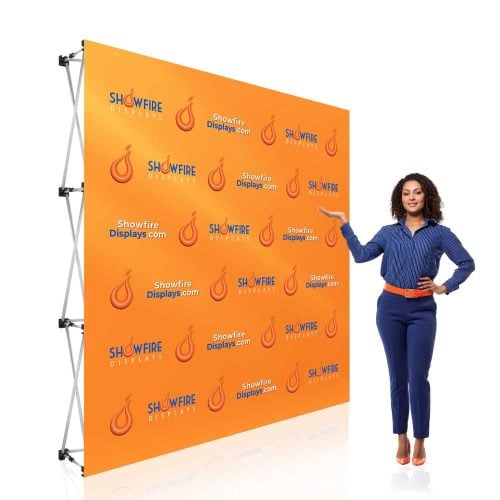
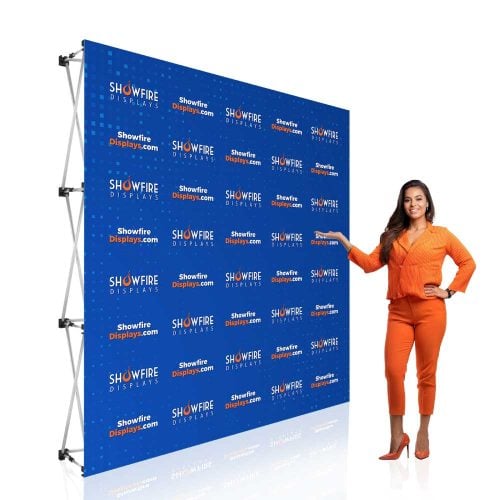
The step and repeat banner is the most common format you will see at red carpet events, corporate conferences, and brand activations. It is a printed panel -- typically on fabric or vinyl -- that attaches to an adjustable backdrop frame. The graphic wraps or clips to the frame and can be swapped out when the design needs to change, which makes this format popular with marketing teams managing multiple events per year.
Fabric banners are the preferred choice for most indoor applications. The material is wrinkle-resistant, folds flat for travel, and produces sharp full-color graphics that hold up well under camera flash and stage lighting. Vinyl banners print at slightly higher resolution and are more durable in outdoor settings, but they are heavier and less forgiving to transport.
Standard widths for this format run from 8' to 10', with 8' x 8' and 10' x 8' being the most frequently ordered. A standard size step and repeat in the 8' x 8' range works well for a single photographer position and gives two or three subjects enough room to stand comfortably without crowding. If your event involves a media line with multiple photographers shooting simultaneously, move up to a 10' wide or wider configuration.
The 10ft step and repeat banner is particularly popular for corporate events where multiple sponsor logos need to appear across the full width without any single logo dominating the layout. This size also scales well for wide-angle photography and video.
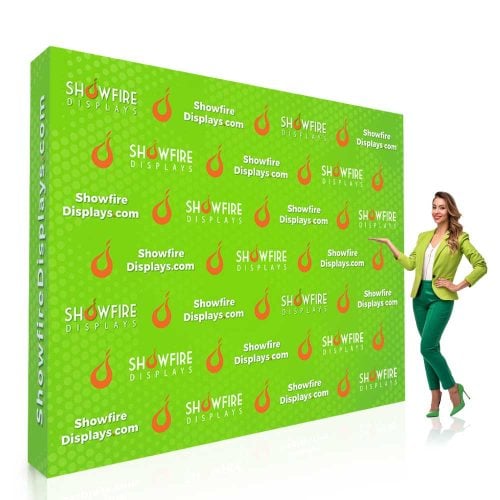
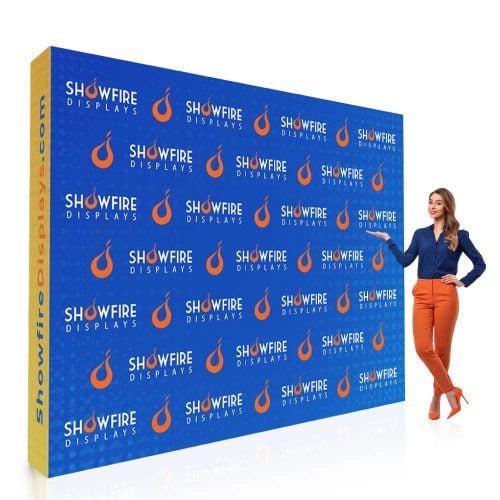
A step and repeat backdrop differs from a banner in the way the graphic is tensioned across the frame. Backdrop systems typically use a pillowcase-style fabric sleeve that slips over a tube frame, creating a taut, seamless surface with no visible hardware. The result is a cleaner, more polished look that performs especially well in professional photography and video settings.
This format is the standard choice for entertainment events, awards ceremonies, and influencer activations where the display will be captured in thousands of photos and the graphic has to look flawless from every angle. The tight fabric tension eliminates the rippling and sagging that can sometimes appear in clip-attached banner systems, particularly under strong lighting.
Step and repeat backdrops are available in the same general size range as banners. The 8x10 step and repeat and 10x10 step and repeat are the two most commonly ordered backdrop sizes, covering the widest range of event photo wall applications. An 8x10 step and repeat gives you a landscape-format wall that photographs well for group shots, while a 10x10 step and repeat provides a more symmetrical frame that works for both portrait and landscape orientations.
The trade-off with backdrop systems is that graphic replacement involves removing the fabric sleeve entirely, which takes more time than swapping a clipped banner. For teams running the same branding across a long event season, that is rarely a problem. For high-frequency event teams updating graphics regularly, a banner-based system may be faster.
If you want to explore the full fabric versus vinyl comparison for backdrops, the step and repeat dimensions and substrate section of the pillar guide covers the specifics in detail.
The step and repeat banner with stand category is designed for buyers who want a complete, ready-to-use system without having to source frame and graphic separately. These kits include the adjustable aluminum frame, the printed banner, and typically a carry bag -- everything arrives together and is confirmed to fit and work as a unit.
This format is especially useful for small events teams, one-person marketing departments, and organizations that do not have a dedicated exhibit house or staging staff. The frame assembles in minutes using tool-free connections, the banner attaches without specialized hardware, and the whole system packs into a carry bag that fits in a standard cargo van or checked luggage.
A step and repeat kit is also the safest option for first-time buyers who are not sure what frame hardware is compatible with which banner format. Buying the system as a bundle eliminates compatibility guesswork entirely.
Common kit sizes mirror the most popular standalone banner sizes -- 8' x 8' and 8' x 10' are the most frequently purchased, with 10' x 8' available for events requiring a wider footprint. The aluminum frames in these kits are adjustable within a range, so a single frame can often accommodate two or three different banner sizes as your needs change.
The step & repeat display format that ships as a complete kit also tends to ship faster than custom-configured standalone products, because the frame hardware is pre-packaged and does not require separate preparation. If your event timeline is tight, this category is worth prioritizing.
For buyers comparing this option against other portable trade show displays and event systems, the complete trade show displays buyer's guide provides a broader context for how step and repeat kits fit within a full event marketing toolkit.
The custom step and repeat category exists for buyers whose requirements do not fit a standard template. This might mean a non-standard size -- a 7' x 12' panel to fit a narrow venue wall, for example -- or a specialized graphic treatment like metallic inks, oversized logo placement, or a layout that breaks from the traditional repeating tile pattern.
Custom configurations also cover requests for branded step and repeat displays with features like integrated lighting loops, velcro-compatible fabric surfaces for interchangeable overlays, or frame systems that double as a room divider. The pop up step and repeat format -- a retractable or spring-loaded frame system -- falls into this category for buyers who prioritize extreme portability and sub-5-minute setup.
Step and repeat printing for custom orders follows the same color standards as the off-the-shelf products, but with more flexibility around bleed, resolution requirements, and layout direction. Showfire's design team can work from a logo file and brand style guide to build a ready-to-print graphic if you do not have an in-house designer, which makes the custom step and repeat backdrop and banner programs accessible to organizations of any size.
If your brand has specific pantone color requirements, photography requirements, or co-sponsor logo placement rules, the custom route is worth the additional lead time. A standard-size step and repeat in an off-the-shelf configuration will ship faster, but it will not accommodate complex layout constraints that many branded events require.
The decision tree for selecting between these four formats is shorter than most buyers expect. Start with three questions:
1. Do you already own a frame?
If yes, you need a replacement banner or backdrop graphic only. Go to the banner or backdrop category depending on your current frame type. If no, continue to question two.
2. How often does the graphic change?
Teams that update graphics frequently -- multiple events per month with different sponsors -- benefit from the banner format because it allows fast graphic swaps without disassembling the frame. Teams running the same branding for a full event season can invest in the cleaner finish of a backdrop system without worrying about the slightly longer changeover.
3. How complex is your brand requirement?
Standard tiled logo layouts, solid color backgrounds, and common widths (8', 10') are all available in the off-the-shelf banner and backdrop categories. If your requirement falls outside those parameters -- non-standard size, metallic finish, complex layout, extreme portability -- start with the custom logo step and repeat category.
Here is a simplified format-matching guide for common event types:
| Event Type | Recommended Format |
|---|---|
| Corporate conference media wall | Step and Repeat Banner or Backdrop |
| Red carpet / awards ceremony | Step and Repeat Backdrop |
| Trade show booth background | Step and Repeat Banner With Stand Kit |
| Charity gala or fundraiser | Custom or Standard Backdrop |
| Pop-up retail or experiential | Custom or Banner Kit |
| Small business event with one staff member | Banner With Stand Kit |
| Influencer or brand activation | Custom Backdrop or Backdrop |
Beyond format, size is the second major variable. The most frequently asked sizing questions are answered in the step and repeat sizes section of the pillar guide, which covers both standard widths and the minimum graphic resolution needed at each size to print cleanly. Reviewing that resource before you upload artwork will prevent most of the file-related delays that slow down production.
For buyers who are also equipping a full trade show booth -- not just looking for a photo wall -- the broader context of trade show booth displays at Showfire shows how step and repeat systems work alongside popup displays, tension fabric booths, and table-top graphics in a coordinated exhibit program.
It is worth briefly addressing why the step and repeat format has remained the dominant choice for event photo walls and brand backdrops, rather than large-format printed posters, tension wall systems, or projection screens.
The repeating logo pattern solves a specific practical problem: no matter where the photographer is standing or what angle the shot is taken from, at least one full, unobstructed logo instance will appear in the frame. A single centered logo on a backdrop is vulnerable to being cropped or blocked; a tiled grid of logos across the full panel surface is not. That is the design logic behind the format, and it is why sponsors and event organizers default to it when brand visibility in photos is a priority.
Additionally, the substrate and frame systems used in modern step and repeat displays are genuinely portable in a way that projection screens and rigid panel systems are not. A fabric step and repeat banner folds into a bag that fits in an overhead compartment. An aluminum frame for an 8' x 8' display breaks down into a bundle under 50 pounds that one person can carry. That portability means the same display can cover a Monday product launch in one city and a Friday gala in another without shipping freight.
The step and repeat banner printing process at Showfire uses dye-sublimation for fabric graphics and UV-resistant ink sets for vinyl, so colors stay accurate across print runs and do not fade noticeably under repeated lighting exposure. That consistency matters when your display is traveling to events where no two lighting rigs are identical.
Every format in this category -- banners, backdrops, complete kits, and custom builds -- is available to configure and order directly through Showfire Displays. Start with the format that fits your event type using the guidance above, then move into the specific product pages to select your size, choose your substrate, and upload your artwork or request a design consultation.
If you are still deciding, revisit the step and repeat for events pillar guide for a side-by-side comparison of all format options, or go straight to the step and repeat banner stand or custom step & repeat pages to see what is currently available and in stock. Showfire's team is also available to answer pre-purchase questions -- reach out directly if you have a non-standard size, a multi-unit order, or a deadline that requires expedited production.