




Step and Repeat Displays
Step and Repeat Examples and Ideas for Events and Trade Shows
If you are planning a branded backdrop for your next event or trade show booth, a good step and repeat example goes a long way toward helping you visualize what works before you commit to printing. These displays are everywhere, from red carpet premieres to corporate conferences, and the best ones share a handful of repeatable traits. This article breaks down real-world step and repeat ideas across different event types so you can walk away with a clear picture of what to build.
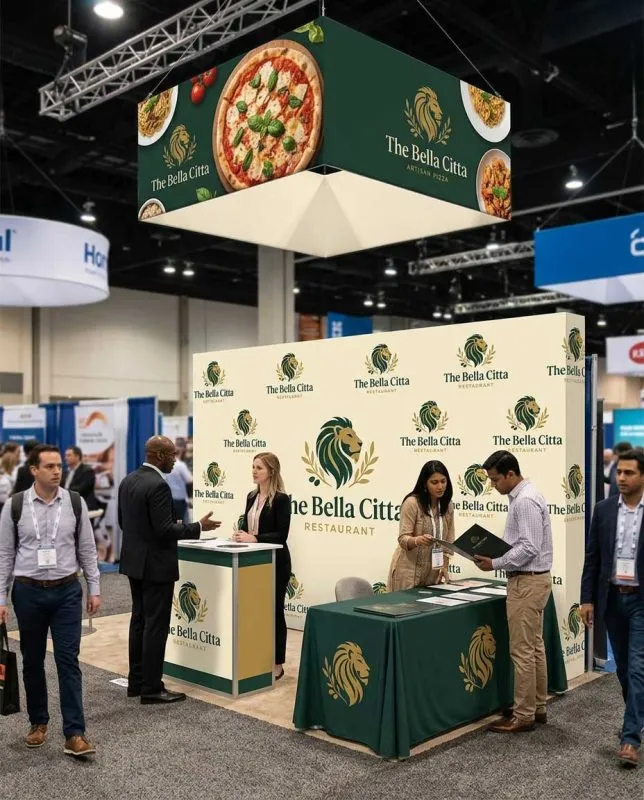
For a deeper look at sizing, materials, and hardware choices, the complete guide to step and repeat displays covers those fundamentals in full. Here we focus entirely on what the finished product looks like in practice and how to adapt it for your specific setting.
What Makes a Strong Step and Repeat Example?
A step and repeat banner tiles a logo or graphic pattern across the entire face of the display so that the brand name or imagery stays visible in photos no matter where a subject stands in front of it. That is the core mechanic, and if you want to understand what is a step and repeat, its meaning, origin, and how it is used, that background context helps clarify why the format is so effective. What separates a forgettable backdrop from one that earns its floor space is contrast, spacing, and restraint.
The strongest examples share three qualities:
- High contrast between the logo and the background. A dark navy background with a white logo reads clearly in dim ballroom lighting or under bright trade show LEDs. A light gray logo on a white background disappears in almost every photo.
- Comfortable tile spacing. Logos that are packed too tightly feel cluttered. Logos spaced too far apart mean a full-body photo might show only one partial repeat. A good rule of thumb: the logo tile should repeat often enough that at least two full tiles appear behind a single person standing in front of the display.
- A single focal element. The most effective step and repeat example you will find in professional event photography is usually built around one dominant logo or wordmark, not four different sponsor marks fighting for attention.
Step and Repeat Example by Event Type
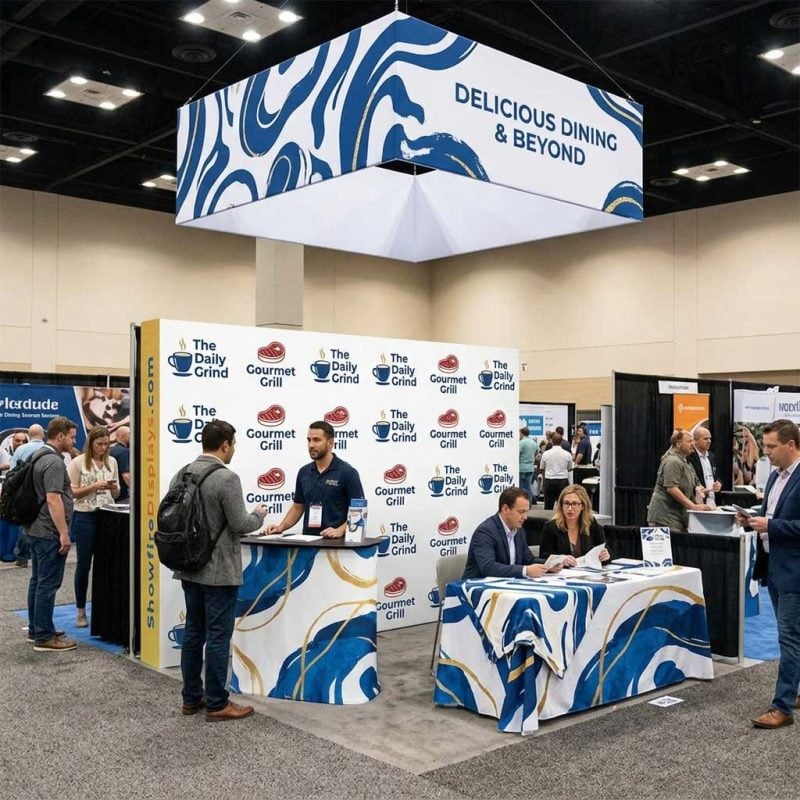
Trade Show Booths
A 10′ x 8′ or 10′ x 10′ backdrop behind a product demo station is one of the most common trade show applications. Here is a concrete scenario: imagine a software company exhibiting at a regional tech expo in a 10′ x 10′ inline booth. Their backdrop uses a dark charcoal background with the company logo in white, repeated in a diagonal grid pattern at roughly 18″ intervals. Product photography shot at the booth is clean, branded, and usable in post-show marketing without additional editing.
If you are shopping for the hardware to hold that backdrop, our step and repeat displays product page shows the frame systems and size configurations we carry. For a larger island booth that also uses overhead branding, it is worth reading the trade show hanging banner guide alongside this article, because a hanging sign and a floor-level step and repeat often work together as a matched set.
Corporate and Networking Events
Galas, awards dinners, and professional association meetings lean heavily on step and repeat backdrops at their check-in and photo areas. A common and effective step and repeat example here is a full bleed background color (matching the event’s brand standards) with the organization’s logo alternating with the event’s official name or year. The alternating pattern solves a practical problem: even if a photographer crops tightly, at least one of the two elements stays visible.
Sizing for these events typically runs taller than a trade show backdrop. An 8′ x 10′ or 8′ x 12′ portrait orientation suits a venue with a high ceiling and allows full-length photos without cropping at the knees.
Product Launches and Press Events
A product launch is where a step and repeat example gets its most aggressive workout. Camera crews, journalists, and social media content teams are all shooting simultaneously from different angles and distances. The winning approach here is a high-resolution brand mark printed on fabric at large tile sizes, roughly 24″ to 30″ per repeat, so the logo stays legible even in a wide establishing shot from across the room. A matte fabric surface reduces glare under studio lighting, which is a meaningful advantage over gloss vinyl in this context.
Charity Galas and Nonprofit Fundraisers
Nonprofits often co-brand their backdrops with sponsor logos, which is where layout discipline becomes critical. A well-constructed step and repeat example for a charity event typically places the nonprofit’s logo in the primary (larger) tile position and rotates sponsor marks into a secondary (smaller) tile row beneath it. This hierarchy keeps the event’s identity front and center while still giving sponsors the exposure they paid for.
| Layout Zone | Logo Size | Suggested Repeat Interval |
|---|---|---|
| Primary (host/nonprofit) | Large | Every 20″ to 24″ |
| Secondary (title sponsor) | Medium | Every 16″ to 20″ |
| Tertiary (supporting sponsors) | Small | Every 12″ to 16″ |
Step and Repeat Ideas Worth Borrowing
Can you provide some examples of step and repeat banners that go beyond the standard diagonal grid? Absolutely. Here are formats we see working well for clients across different industries:
Alternating color rows. Use two background colors (both on-brand) in horizontal bands, with the logo reversed out of each. The color shift creates visual depth without requiring complex artwork.
Single-logo large-format center. For a company with strong brand recognition, place one oversized logo dead center and frame it with a subtle texture or pattern fill. This works particularly well for celebrity meet-and-greets and VIP photo ops.
Border frame with open center. The logo tiles run as a dense frame around the outer edges, leaving the center of the display open (or filled with a solid color). This keeps the backdrop interesting in wide shots while giving portrait photos a clean background behind the subject’s face.
Geometric or gradient backgrounds. A subtle gradient from a deep brand color to a lighter tint behind a grid of white logos adds dimension that photographs beautifully and stands out in a crowded event hall.
If you are building out a full booth alongside your step and repeat, the fabric pop up display guide is a useful companion resource for understanding how fabric backwall displays differ from a traditional step and repeat frame and which format suits which use case.
Practical Details Before You Order
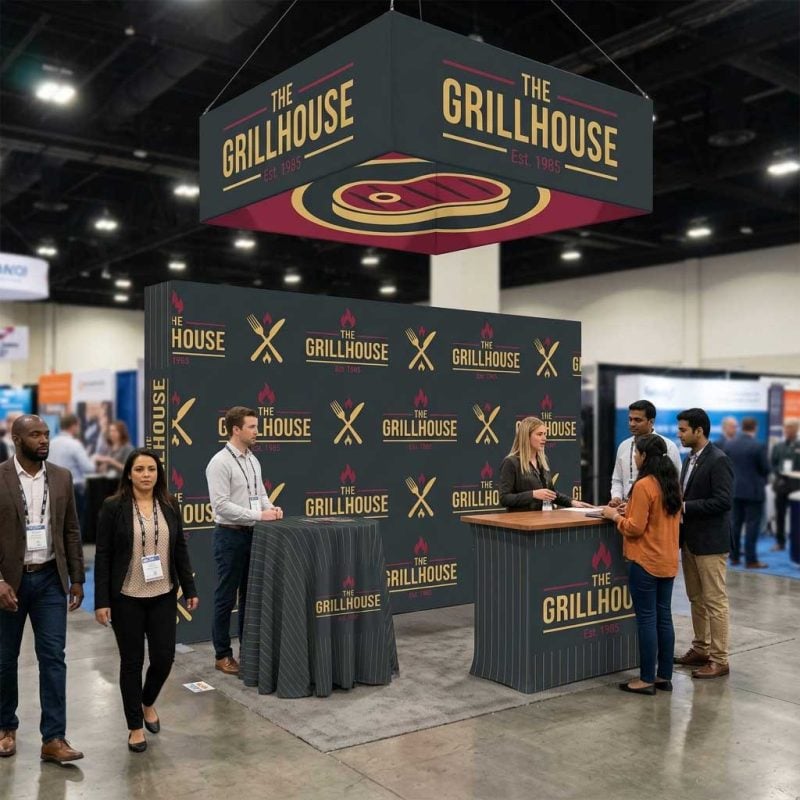
Size and Orientation
| Common Size | Best Use |
|---|---|
| 8′ x 8′ | Small booth, intimate event check-in |
| 8′ x 10′ | Standard trade show inline booth |
| 10′ x 8′ | Landscape orientation, wide photo area |
| 10′ x 10′ | Large booth backdrop, press event |
| 8′ x 20′ | Conference main stage, wide venue |
File Setup
Your artwork should be submitted at the full print dimensions. Keep logos in vector format where possible. If your brand only has a raster logo, the minimum recommended resolution at final print size is 150 dpi (dots per inch). For a solid step and repeat example with clean, sharp edges, avoid upscaling a small PNG to fill an 8′ x 10′ canvas, and refer to our Photoshop step and repeat trade show layout how-to guide for help building your artwork file correctly.
Free Mockup Before You Print
One thing we do at ShowFire Displays that clients consistently find valuable: our designers create a free mockup using your actual artwork before anything goes to print. You see the tiled layout, the spacing, and the color rendering on your chosen background before you approve the job. This eliminates the guesswork and catches contrast or spacing problems while there is still time to fix them.
Ready to Build Yours?
A well-designed step and repeat example from a real event shows you exactly what is achievable, and the ideas above give you a solid starting point for your own backdrop, whether you are exhibiting at a trade show, hosting a gala, or staging a product launch.
If you are early in your overall exhibit planning and want to understand how a step and repeat fits alongside your other displays, the trade show displays buyer guide maps out the full range of display types and helps you prioritize your budget across the whole booth. And when you are ready to spec your backdrop, browse our step and repeat printing options to see sizes, fabric choices, and frame configurations, or reach out and we will start with that free mockup on your artwork.


