Need Assitance?
Call us at 844-203-6588.
We Accept

Your logo belongs front and center at every photo opportunity your brand creates -- and a custom step and repeat is the format built specifically for that job. Unlike generic signage, a custom step and repeat puts your brand identity into a repeating tile pattern that reads clearly in every photo, at every angle, from every distance. This page walks through who benefits most from a fully personalized display, what to think about before you order, and how to choose the right format from Showfire Displays' lineup. If you're new to this format entirely, the step and repeat buying guide covers the fundamentals in full detail before you dive into specific product decisions.
There is a meaningful difference between a display that carries your branding and one that is built around your branding. Off-the-shelf backdrops offer convenience but force your brand to adapt to whatever layout, color, and proportion they ship with. A custom step and repeat reverses that relationship -- the display adapts to your brand files, your color palette, and your logo arrangement.
That distinction matters most during high-visibility moments: red-carpet arrivals, corporate anniversary celebrations, charity galas, product launches, and any gathering where attendees will photograph themselves against a backdrop. In those moments, the display is not background scenery -- it is an active piece of brand communication that reaches every person who sees the photos afterward.
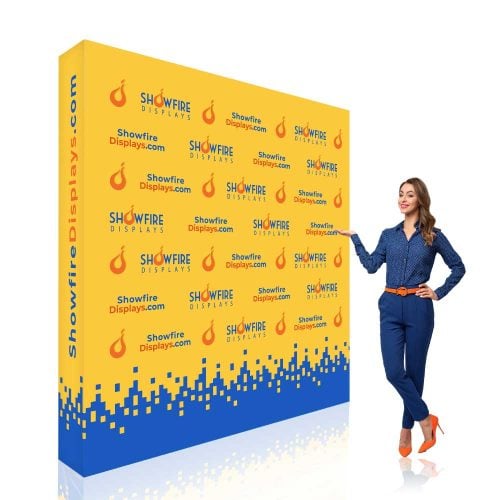
The step and repeat displays collection at Showfire Displays is built on that premise: every format in the lineup starts with your artwork, not a stock template.
A personalized step and repeat serves a wide range of buyers, but certain use cases see a disproportionate return on the investment.
Corporate event teams ordering for annual conferences, product launches, or sponsor-recognition walls need a display that reflects multiple brand identities without looking chaotic. A logo step and repeat lets you arrange sponsor logos in a deliberate grid that photographs cleanly and satisfies contractual brand placement requirements.
Marketing agencies producing branded activations for clients routinely order a custom step and repeat for each campaign. The ability to swap artwork between events -- often using the same hardware -- makes the format cost-effective over a multi-event calendar.
Non-profit organizations hosting fundraising galas or recognition dinners use personalized step and repeat displays to create a sponsor showcase at the photo station, giving donors visible credit in every image that circulates from the event.
Sports teams and athletic programs use the format for draft day events, signing ceremonies, and media days. A custom logo step and repeat gives television cameras and photographers a clean branded background that reinforces team identity without competing with on-field signage.
Retail brands and product launch teams find the format equally useful at pop-up activations, where foot traffic is high and social sharing is part of the campaign strategy. A well-designed custom step and repeat banner in that context functions as a visual anchor for user-generated content.
The "custom" decision does not end at artwork -- it extends to format, material, and hardware. Showfire Displays offers several distinct step and repeat configurations, and the right one depends on how you plan to use and transport the display.
Fabric prints are wrinkle-resistant, lightweight, and absorb light rather than reflecting it -- which means they photograph cleanly under flash photography and event lighting. Vinyl prints are more rigid, more resistant to outdoor conditions, and generally the better choice for displays used in lobbies, trade corridors, or outdoor environments where wind and weather are factors.
If your primary use is an indoor photo backdrop at a gala or conference, fabric will almost always produce a better photographic result. If the display needs to hold up across outdoor activations or rough transport conditions, vinyl offers durability advantages.
The three main format choices each suit a different event context.
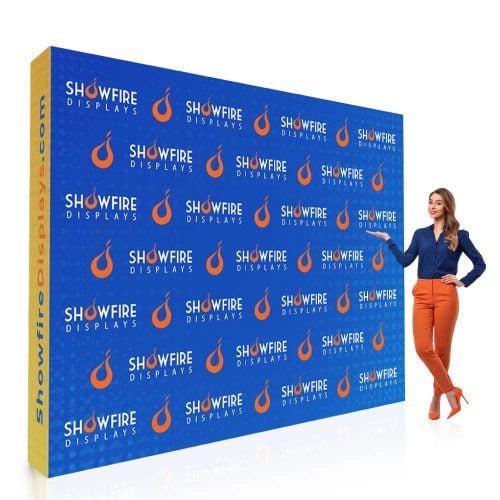
A step and repeat banner is the most versatile entry point -- flat-printed, available in fabric or vinyl, and compatible with a wide range of stand hardware. If you already own a banner stand or your event venue provides hardware, a banner-only order keeps costs lean.
A step and repeat backdrop typically refers to a larger format display optimized specifically for photo-station use. The finishing and material choices on a custom step and repeat backdrop are weighted toward photography performance -- matte surfaces, clean hems, and a flat hang that eliminates background distractions.
For buyers who want everything handled in one order, the step and repeat banner with stand bundles the printed graphic with the hardware system. This is the most efficient option for teams that travel between events or need a setup that one person can deploy without tools or assembly experience.
Sizing a custom step and repeat correctly depends on two factors: the space available and the number of people who will typically stand in front of it. A wider display accommodates group shots and keeps the branded tiling visible even at the edges of a wide-angle photograph. A taller display ensures the logo pattern remains in frame when photographers shoot from a low angle or when taller subjects are photographed.
The step and repeat banner size guide provides detailed guidance on standard proportions and how to match display dimensions to your venue footprint and photography setup. Consulting that resource before finalizing dimensions will prevent the most common ordering mistake: choosing a size that looks large in isolation but reads as cramped in photographs.
| Display Use Case | Recommended Format | Material Consideration |
|---|---|---|
| Indoor gala / award ceremony | Backdrop or banner | Fabric (matte finish) |
| Outdoor brand activation | Banner | Vinyl (weather-resistant) |
| Traveling between events | Kit with stand | Lightweight fabric |
| Trade show photo station | Backdrop or banner | Fabric or vinyl |
| Lobby / permanent installation | Banner | Vinyl (durable) |
A personalized step and repeat banner performs best when the logo tile is designed for the specific display dimensions rather than scaled from a one-size file. The tile should be sized so that logos appear at a legible scale from 6 to 10 feet away -- the typical distance at a photo station. Logos that are too small get lost in the photograph; logos that are too large break the repeating grid that makes the format distinctive.
Showfire Displays' production team reviews artwork before printing. Submitting vector files (AI, EPS, or high-resolution PDF) gives the prepress team the most flexibility to adjust tile sizing and spacing for the selected display dimensions. If you are working with a marketing agency or in-house design team, request files in vector format before placing your order -- it avoids delays at the proofing stage.
Before finalizing a custom step and repeat order, work through the following questions. They address the most common sources of post-order regret.
How many events will this display serve? If the answer is one or two, a vinyl banner-only order may offer the best cost-to-value ratio. If the display will be reused across a season or multi-year event calendar, investing in a fabric backdrop with a quality stand pays back quickly through durability and consistent photo results.
Who is setting it up? If setup falls to a single person at the venue -- no AV crew, no event production team -- prioritize a kit format that includes all hardware and assembles without tools. The step and repeat kit format is specifically designed for that scenario.
Does this display need to serve trade show environments as well? If you are planning to use the display at both branded events and trade shows, it is worth reviewing the complete trade show displays buyer's guide to understand how step and repeat formats fit within a broader booth strategy -- and whether additional display formats would complement your setup.
What is your turnaround requirement? Production and shipping timelines vary by order complexity. Standard custom orders ship faster than multi-panel configurations or oversized formats. Confirm the lead time at order placement if you are working toward a fixed event date.
A custom step and repeat delivers something that generic signage cannot: a display that is built entirely around your brand, performs consistently in photography, and gives every attendee a clear, repeatable association between your logos and the event experience. That combination is hard to replicate with any other format at a comparable price point.
Showfire Displays prints every custom step and repeat with attention to color accuracy, material finish, and tile registration -- the details that separate a display that looks right in person from one that looks right in photos. Browse the full step and repeat printing collection, select the format that fits your event, and upload your artwork to get started. If you have questions about sizing, material, or file preparation before ordering, the team is available to walk you through the options.