Need Assitance?
Call us at 844-203-6588.
We Accept

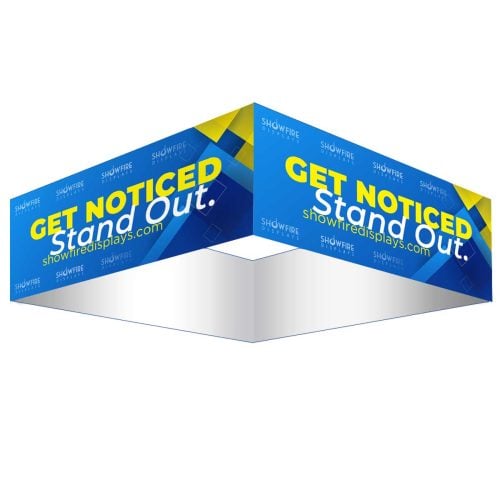
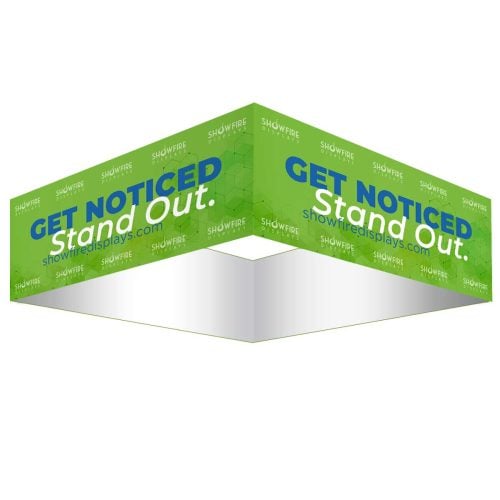
Overhead real estate at a trade show is some of the most valuable square footage in any exhibit hall, and the 10ft square hanging banner occupies it with authority. At this size, the display is large enough to be readable from across a busy floor, yet compact enough to fit comfortably inside a standard 10' x 10' or 10' x 20' booth footprint. Exhibitors who have wrestled with whether to go smaller and sacrifice visibility or go larger and risk overwhelming their space consistently find that the 10ft format resolves the tension cleanly. This page covers everything you need to know before placing your order -- from print options to rigging logistics to how this size stacks up against the rest of the square family.
The geometry of a 10ft square hanging banner is deceptively simple, but its practical advantage is real. All four faces present the same dimensions, so your brand graphics wrap evenly on every side -- no awkward aspect ratio adjustments between faces. When attendees approach from any direction, the message reads at the same scale and proportion.
That consistency matters in dense exhibit environments where foot traffic flows unpredictably. A visitor walking a parallel aisle 30 feet away sees the same crisp logo and color block as someone standing directly beneath the sign. That 360-degree legibility is exactly what makes a trade show hanging banner worth the overhead rigging investment.
The 10ft size also falls into a sweet spot for rigging labor. It is substantial enough that venues treat it as a serious anchor display, yet it does not demand the multi-point rigging setup that larger formats require. Most convention centers can accommodate a single-point or four-point suspension at this scale without escalating to a premium labor tier.
Not every exhibitor needs the same footprint above their booth. Here is a straightforward breakdown of the scenarios where the 10ft square hanging banner consistently delivers the strongest return:
| Booth Size | Typical Use Case | Why 10ft Works |
|---|---|---|
| 10' x 10' | Solo brand presence | Fills the overhead zone without spilling past the booth boundary |
| 10' x 20' | Multi-product brand | Anchors one end of a linear booth while floor displays handle the rest |
| 20' x 20' island | Supporting sign | Pairs with a larger centerpiece ceiling sign to mark a sub-zone |
| Outdoor canopy tent | Branded event display | Visible above canopy structure when rigged from tent frame |
| Retail pop-up | Interior wayfinding | Guides shoppers to a specific department or feature area |
Brands debuting at their first major trade show often gravitate to this size because it is approachable from a budget standpoint and straightforward to set up. Seasoned exhibitors use it as a secondary anchor when their main display is a larger format -- for instance, pairing it alongside a custom 12ft square hanging banner to create distinct zones within a larger island booth.
If you are working with a smaller booth or a tighter budget, the 5ft square hanging banner is worth a look as a compact alternative, while teams with a mid-size island and room to go bigger often step up to the 8ft square hanging banner or explore the 10ft and 12ft options side by side before committing.
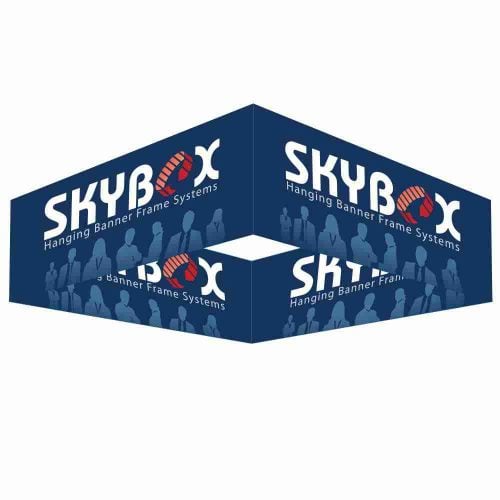
Square hanging banners are typically available in single-sided and double-sided print configurations. A single-sided build uses one printed fabric panel, which means only one face displays your graphic while the reverse remains blank or shows a neutral backing. Double-sided printing puts your artwork on all visible faces, which is the better choice for any location where attendees can approach from multiple directions -- which describes virtually every open trade show floor.
For a hanging banner for exhibit booth applications, double-sided print is almost always the correct call. The incremental cost is modest relative to the visual impact, and it prevents the awkward moment where half your audience is looking at an unprinted surface.
The fabric used on a quality square ceiling banner is a lightweight stretch polyester printed via dye-sublimation. Dye-sub ink is absorbed into the fiber rather than sitting on top of it, which means colors do not crack, peel, or fade with repeated assembly and disassembly. For brands with precise Pantone or CMYK color requirements, dye-sublimation on tension fabric produces results that hold up across dozens of show cycles.
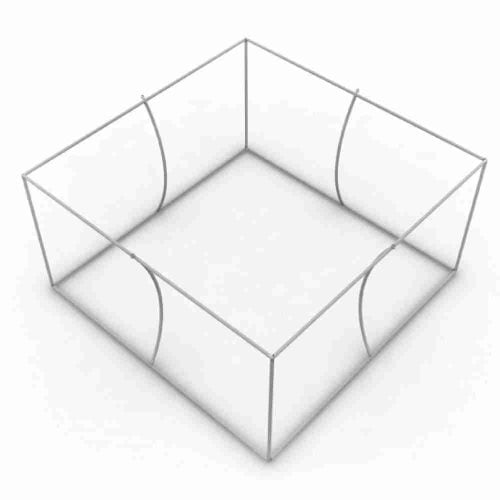
The tension the fabric exerts against the frame also matters. A well-engineered hanging sign uses a frame specifically sized so the fabric pulls taut without distortion, keeping logos and text crisp rather than wavy. Ask your vendor about frame material -- aircraft-grade aluminum tubing is the standard for portable hanging signs because it balances stiffness with low pack weight.
A complete kit should include the aluminum frame, the printed fabric graphic, and rigging hardware -- at minimum, a swivel attachment point at the top. Many exhibitors add a motor or manual rotator so the sign spins slowly, keeping all four faces in play over time. Confirm that the hardware included is rated for the weight of the assembled display and meets the venue's rigging compliance requirements.
Trade show ceiling banners must often be submitted for advance approval to the show's official rigging contractor. Pull the exhibitor manual for your specific show well in advance and confirm lead times, because most rigging orders close 30 days before the event opens.
The 10ft format sits in the middle of the square lineup. If the proportions or the budget do not match your needs, the adjacent sizes are worth a direct comparison:
| Size | Best Fit | Approximate Canopy Area |
|---|---|---|
| 5ft | Small kiosks, tabletop environments | 25 sq ft |
| 8ft | Standard 10' x 10' booths | 64 sq ft |
| 10ft | 10' x 10' to 10' x 20' booths | 100 sq ft |
| 12ft | Mid-size island booths | 144 sq ft |
| 15ft | Large island and corner booths | 225 sq ft |
| 20ft | Anchor or centerpiece displays | 400 sq ft |
If your exhibit footprint grows in future seasons, you can step up to the 12ft square ceiling banner or the 15ft square hanging banner without changing your graphic approach -- the shape and print process are identical, only the scale shifts. Teams running very large island exhibits should also evaluate the 20ft square hanging sign as a centerpiece anchor.
One of the practical wins for the 10ft format is that it typically packs into one or two carry bags that check as standard baggage or ship via ground freight without dimensional weight surcharges that plague larger formats. The frame breaks down into sections that fit within manageable bag lengths, and the fabric rolls or folds into a compact pouch. For exhibitors who fly to shows and hand-carry their display, this is a meaningful logistical advantage over the 15ft and 20ft sizes.
A 10ft square hanging banner rarely lives in isolation at a well-planned booth. It typically serves as the overhead identifier that orients attendees from a distance while floor-level displays -- backwalls, counters, and banner stands -- handle the detail selling work up close. The overhead sign answers the question "who is that?" while the surrounding exhibits answer "what do they offer?"
If you are still working out the full picture of your booth, the trade show hanging banner guide covers the complete shape and size selection process in detail, including how to match overhead signage to different booth configurations. For a broader view of how hanging signs fit within a full exhibit program, the trade show displays buyer guide walks through every major display category from backwalls to counters to overhead elements.
The square hanging banner with hardware category page also lists the full size range side by side if you want to explore the whole family before settling on a size.
It is also worth noting that exhibitors who have used round hanging banners or other shapes in the past often switch to the square format specifically for the consistent four-face geometry. Unlike round hanging banners, where the curved surface can complicate logo placement near the edges, a square format gives you four flat, rectangular faces that work naturally with standard brand lockups and horizontal text layouts.
You have done the research -- now the decision comes down to finalizing your graphic and submitting your order early enough to meet your show's rigging deadline. Start by confirming the show's advance rigging cutoff, then work backward to set your print production and ship date. Dye-sublimation fabric signs typically require a few business days of production time after art approval, plus transit.
If you need help selecting between sizes or have questions about double-sided print configuration, contact the Showfire Displays team. Upload your artwork, choose your print options, and get your 10ft square hanging banner production-ready before your next event.