




Canopy Tents
Canopy Tent for Rent vs. Buy: A Trade Show Cost Decision Chart
If you are weighing a canopy tent for rent against an outright purchase before your next trade show or outdoor event, the short answer is this: renting almost always costs more over time, and buying wins by a wide margin for anyone who exhibits more than twice a year. That said, the right call depends on frequency, storage, and how much customization your brand actually needs. This article walks through every variable so you can make the decision in minutes, not days.

Why the Rent vs. Buy Question Comes Up So Often
Canopy tents are a staple at outdoor trade shows, farmers markets, street fairs, corporate activations, and sporting events. When a company is new to live events, the upfront cost of a custom-printed tent feels steep compared to a simple canopy tent rent from a local party supply house or event rental company. That instinct is understandable, but it ignores a few costs that rental companies rarely advertise upfront.
Rental fees for a 10′ x 10′ commercial canopy typically include the frame and a plain white or solid-color canopy top. If you want any branding at all, you are usually paying for clip-on banners or hanging signs separately. After two or three events, those rental receipts quietly add up to what a custom tent would have cost, and you still own nothing at the end.
The Core Variables: What Actually Drives the Math
Before you can decide whether a canopy tent for rent is the smarter move, you need honest numbers on four variables.
1. How many events per year do you attend?
One or fewer events annually is the clearest case for renting. Two to four events puts you in a gray zone. Five or more events per year makes ownership almost always cheaper within the first calendar year.
2. What is your branding requirement?
Rental tents are generic. If your booth needs a printed roof, full sidewalls with your logo, or a branded rail skirt, rental companies either cannot provide them or charge a premium that closes the cost gap fast.
3. Do you have storage space?
A 10′ x 10′ tent packs into a carry bag roughly the size of a golf bag. A 10′ x 20′ tent is larger but still fits in a standard storage closet or cargo van. Storage is rarely the obstacle people assume it will be.
4. Who sets up and tears down the tent?
Rental companies typically handle delivery, setup, and breakdown, which can be worth real money if your team is small or the event venue is far away. Ownership transfers that labor to you, so factor that in honestly.
Rent vs. Buy Decision Chart
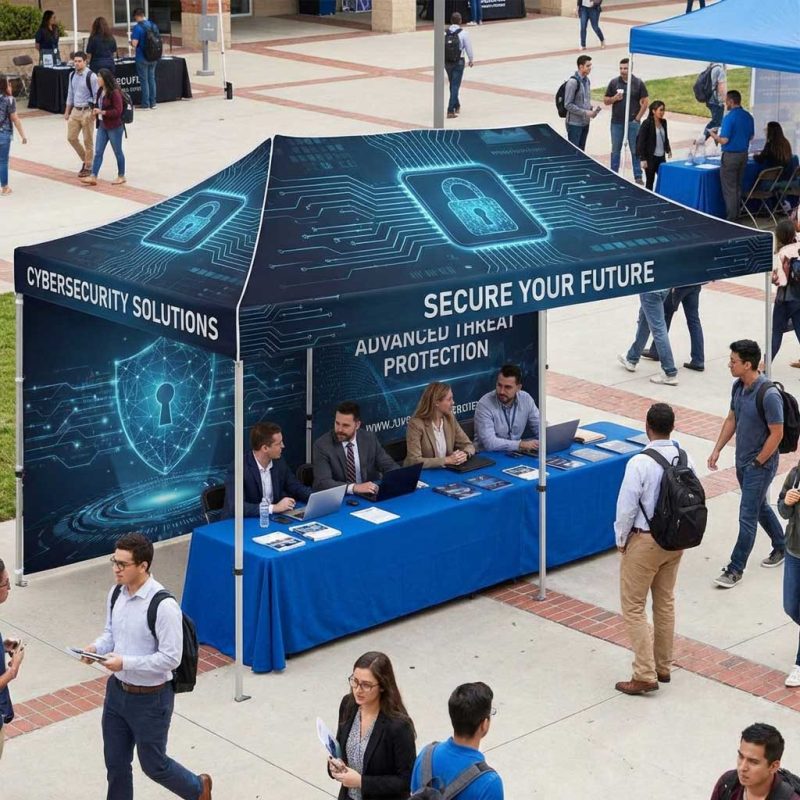
The table below maps the most common exhibitor profiles to the recommended choice. Use the column that best matches your situation.
| Exhibitor Profile | Annual Events | Branding Need | Recommended Choice |
|---|---|---|---|
| First-time exhibitor, testing the market | 1 | None or minimal | Rent |
| Small business, occasional shows | 2 to 3 | Logo preferred | Buy (pays off by event 3) |
| Regional brand, active show season | 4 to 6 | Full custom print | Buy (pays off by event 2) |
| National brand, year-round activation | 7+ | Full custom print | Buy (significant savings) |
| One-off corporate event, no reuse planned | 1 | None | Rent |
| Non-profit, irregular events | 1 to 2 | Logo preferred | Buy or borrow |
The breakeven point for most custom-printed 10′ x 10′ tents lands between events two and three when you compare the purchase price against average rental fees in the US market. After that crossover, every event you attend with your own tent is money you keep.
A Real-World Scenario: The Regional Food Brand
Picture a regional hot sauce brand that does six farmers markets and two trade shows per summer. In year one, they rented a canopy tent for rent at each event, spending roughly the equivalent of a mid-range custom tent purchase over those eight events, with nothing to show for it in year two. When they switched to owning a custom-printed 10′ x 10′ tent with half walls, their per-event display cost dropped to almost zero (excluding travel and fees). By the end of the second season, the tent had paid for itself twice over and their booth looked dramatically more professional than the plain white rental next to them.
That is not an unusual story. It is the story of nearly every small business that makes the switch.
What a Custom Tent Actually Includes
When you rent a canopy tent, you get a commodity product with no identity. When you buy a custom tent, you get a fully branded booth structure designed around your artwork. Our custom canopy tents are available with printed roofs, full walls, half walls, and rail skirts, all in commercial-grade materials built to handle repeated setup and outdoor conditions.
One thing that removes a lot of hesitation for first-time buyers: our designers create a free digital mockup using your actual artwork before anything goes to print. You see exactly how your logo and colors will look on the tent canopy, sidewalls, and any accessories before you commit.
Practical Ownership Tips That Rental Avoids (But You Should Know)

If you decide to buy, two operational details matter more than most people realize.
Anchoring and weighting the tent correctly is not optional at outdoor events. Wind loads on a fully printed canopy top are higher than on a plain white rental top because printed fabric catches more air. Our guide on weight for canopy tent legs breaks down exactly how much ballast you need by tent size and expected wind conditions, and it is worth reading before your first outdoor show.
Packing the tent down properly after each event also extends its lifespan considerably. Forcing poles the wrong direction or rolling the canopy while damp are the two most common ways exhibitors shorten the life of a tent they just paid for. Our step-by-step article on how to fold a canopy tent covers the exact technique so you do not damage the frame or fabric between shows.
When Renting Still Makes Sense
There are legitimate cases to rent a canopy tent. If your company is sending someone to a one-time trade show in a city where shipping a large tent would cost more than the rental, that calculation changes. If you are evaluating a new market before committing to a branded presence, a rental lets you test the waters without risk. And if the event organizer requires a specific tent frame or color that you do not already own, renting the structural component while supplying your own printed graphics (if the rental company allows it) can be a reasonable middle ground.
The key is to do the math explicitly. Canopy tent on rent fees vary widely by region and vendor, so get an actual quote and stack it against a purchase price with your eyes open.
Canopy Tent for Rent vs. Buy: The Bottom Line
The canopy tent for rent path wins in exactly one scenario: a single event with no anticipated repeat. In every other realistic exhibitor profile, buying a custom tent is cheaper by the second or third event and dramatically better for brand presence at every show you attend afterward.
If you want to understand how tent decisions fit into a broader exhibit strategy, our complete trade show displays buyer’s guide covers the full range of display types, materials, and budgeting frameworks in one place. And if you are also equipping the interior of your booth, the retractable banner stand buying guide and the fabric pop up display guide are useful companions for choosing what goes inside the tent.
The bigger picture is that canopy tents rent out as generic space. Owning one means every event you attend reinforces your brand instead of your rental company’s plain white inventory. For most US exhibitors doing two or more shows a year, that difference alone is worth the investment.
For the full picture on types, sizes, graphics and pricing, read our complete canopy tent buying guide.


