Need Assitance?
Call us at 844-203-6588.
We Accept

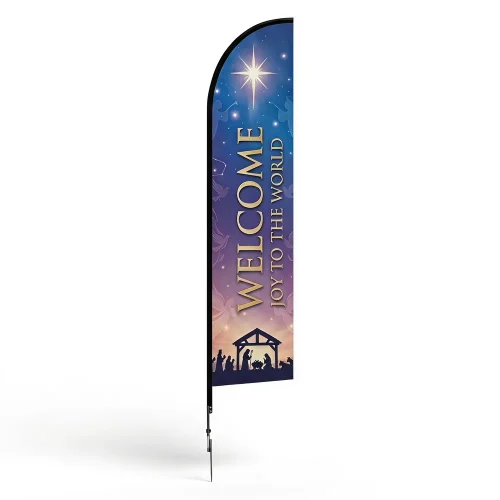
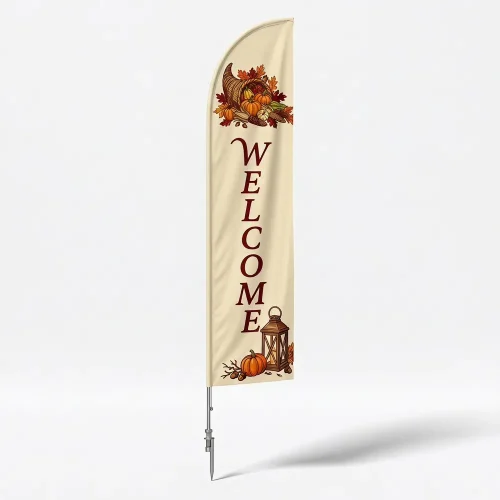
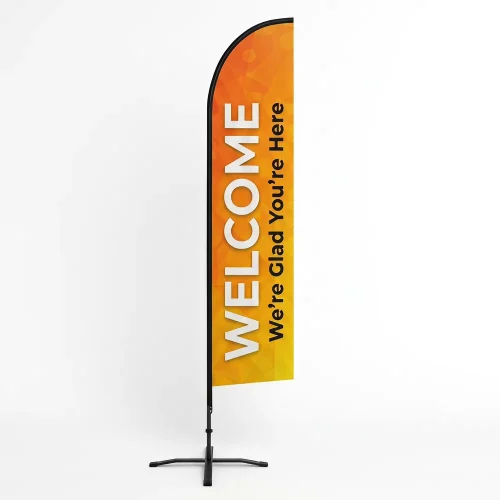
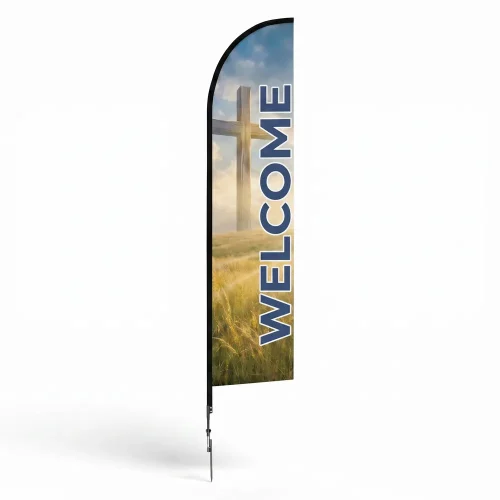
Every time a first-time visitor pulls into your parking lot, that first impression is already forming before they reach the front door -- and a well-placed welcome church feather flag does the quiet work of telling them they are in the right place. These tall, gently waving flags carry a single clear message: you belong here. The collection at Showfire Displays spans ten design styles, giving ministry teams a real range of looks to match their building, brand, and season. Whether you need one flag at the entrance or several flanking a courtyard walkway, the format is built to perform outdoors week after week without demanding constant attention from staff or volunteers. This page walks you through what the collection includes, who it suits best, and what to think through carefully before you order.
The hardest part of buying a feather flag is usually narrowing down the design, not the hardware. The Showfire welcome flag collection offers ten distinct styles, so before you settle on a quantity or plan your physical layout, it helps to understand what each design is doing visually -- and where it will read best on your property.
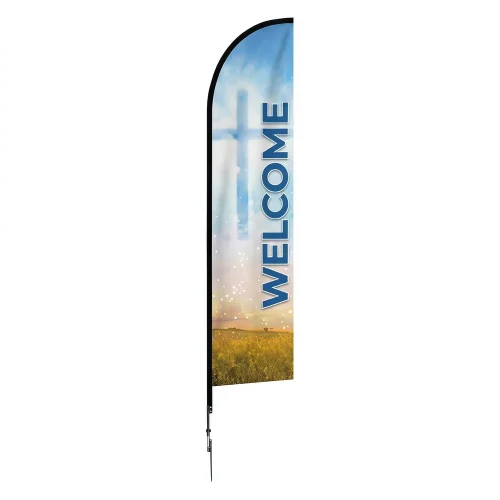
Designs at the lighter end of the spectrum -- like welcome church feather flag style 1 and welcome church feather flag style 2 -- lean toward clean, open layouts with bold typography and minimal graphic clutter. They read quickly from a moving car, which makes them a natural fit for road-facing entrances where a driver has only a second or two to register the message before passing. If your church sits on a busy street or a corner lot with fast-moving traffic, these styles tend to outperform busier alternatives simply because the message resolves faster at distance.
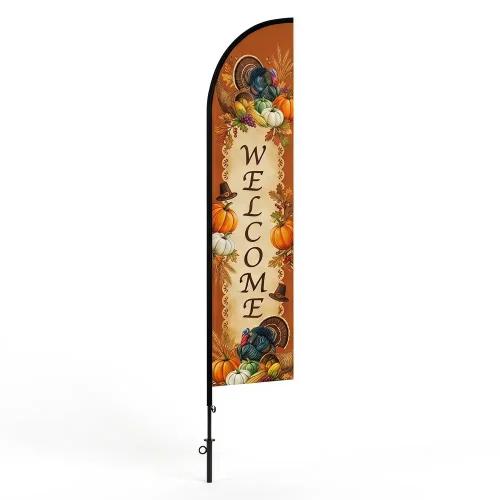
Mid-collection options such as welcome church feather flag style 10 bring in richer color fields and more graphic layering. These work beautifully when flags are positioned close to foot traffic -- near a walkway, a covered porch, or a lobby entrance -- where visitors have a moment to take in the full composition. The additional visual depth rewards proximity in a way that the simpler styles do not.
Styles like welcome church feather flag style 3 occupy a middle ground: enough graphic interest to look intentional and branded, but still clean enough to be legible at twenty or thirty feet. For most suburban church properties where the parking lot itself is the transition zone between the street and the building, these mid-complexity designs hit the widest range of use cases.
If you are not sure which end of the spectrum suits your building and setting, ordering one sample flag before committing to a full set is always a reasonable first move. Running two different styles side by side for a Sunday or two gives you real-world feedback from the people who matter most -- your congregation and your first-time guests.
Welcome flag banners are not exclusively a Sunday-morning tool, though that is where most churches start. The ministries and situations that reach for this format most often share a few common traits: they need outdoor signage that sets up fast, travels easily, and does not require a dedicated install crew.
Growing congregations in outreach mode. When a church is actively inviting new members through community campaigns or neighborhood canvassing, outdoor signage removes friction the moment someone decides to visit. A welcome church feather flag planted at the lot entrance signals openness and intention before anyone reads a website or picks up a program.
Multi-site campuses. Teams managing two or more locations often standardize on a single flag design so the visual language stays consistent across campuses. A visitor who has been to the main campus should feel the same sense of welcome pulling into a satellite location. The ten-style collection makes it straightforward to choose one look and duplicate it at scale.
Event-specific setups. Beyond Sunday services, welcome church flags appear at community picnics, outdoor baptism ceremonies, fall festivals, holiday outreach events, and neighborhood block parties. Because the hardware packs down compactly into a carry bag, these flags travel well in a van or SUV without requiring a dedicated trailer.
Children's and youth ministry entrances. A drop-off lane that clearly signals "Welcome" reduces parent confusion at busy check-in times, especially when a church campus has multiple entrances and ministry wings. Brighter, bolder styles from the collection -- the ones with higher contrast and stronger color -- work especially well in these high-traffic areas where parents are moving quickly and reading signage on the go.
New church plants. Meeting in a school gymnasium, a rented event hall, or a temporary structure? Feather flags are one of the fastest ways to claim a space visually and make a borrowed environment feel intentional when permanent signage is not yet an option. A pair of welcome feather flags at the entrance of a school lobby can transform an anonymous hallway into a recognizable front door.
Getting the most out of your welcome feather flags comes down to a handful of practical decisions. Running through these before you place your order saves time and avoids a second purchase to fill gaps.
Feather flags use interchangeable base systems -- ground spike, cross base, or water-weight base -- and the right choice depends entirely on your surface. A spike drives into grass or soft ground and gives you the most stability in wind, making it the default choice for lawn areas adjacent to a parking lot. A cross base sits on hard surfaces like asphalt or concrete without any anchoring required. A water-weight base is the safest choice near foot traffic because it eliminates tripping hazards while still providing enough ballast for moderate wind conditions. Most church properties end up needing at least two base types depending on the variety of surfaces across their entrances and event spaces.
A single flag at the entrance is better than none, but pairs or rows of three create a stronger visual corridor that guides visitors naturally toward the door. For a standard church entrance, two flags spaced roughly six feet apart on either side of a main walkway is a reliable starting point. If you are lining a longer path -- say, a sidewalk from a large parking lot to a main building -- spacing flags every ten to twelve feet keeps the rhythm consistent without making the setup feel overcrowded.
Taller poles increase visibility from a distance but require more attention in sustained or gusty wind conditions. For properties near a busy road where you want flags visible from passing vehicles, a taller option makes clear sense. For courtyard or close-proximity placement near a building entrance, a mid-height configuration provides better visual proportion without overscaling the architectural surroundings. If your area experiences frequent afternoon wind, anchoring into the ground or weighting the base more heavily is worth the extra step.
These flags are designed for repeated outdoor use. The fabric is lightweight enough to catch a gentle breeze and display the design clearly, and the print is formulated to resist fading under regular sun exposure across an extended outdoor season. If you plan to leave flags positioned across multiple weeks of unpredictable weather, bringing them inside during storms and high-wind events will extend their service life considerably -- and keep the print looking fresh well into the following season.
A welcome flag earns its place year-round, but most churches pair it with a rotating seasonal program. If your team also rotates christmas church feather flags through the Advent and holiday season, building your storage and hardware inventory around that broader calendar saves money over time because the same bases serve multiple flag types. Similarly, coordinating welcome flags with your easter outdoor flags when attendance spikes in spring is a common strategy among growing ministries that want a cohesive outdoor presence across the highest-traffic weekends of the year.
If your church also runs baptism events throughout the year, the baptism church feather flag styles in the same collection share compatible hardware, so one investment in bases and poles covers welcome flags, seasonal flags, and event-specific flags without requiring separate equipment purchases for each type.
Welcome feather flags are one piece of a larger outdoor and indoor display ecosystem that most active ministries build over time. For teams that want to understand how flags fit alongside roll-up banners, canopy tents, table throws, and backdrops -- and how to sequence those purchases in a way that makes sense for a budget -- the church banner ideas guide on Showfire covers all the major format categories in one comprehensive reference.
If you are coordinating a flag program across a larger ministry footprint, or your church hosts community expos, health fairs, or outreach events where a more extensive display setup is needed, the complete trade show displays buyer's guide covers the broader landscape of portable display systems -- from pop-up frames to tension fabric structures -- that can complement and extend your existing church signage investment.
The church flag banners collection at Showfire is designed so that each flag, base, and pole component works across multiple design styles and seasonal themes. That interoperability matters more than it might seem at first. As your needs expand -- adding a holiday flag, rotating in a fresh welcome church feather flag design after a rebrand or facility renovation -- you are not rebuilding the hardware kit from scratch each time. The initial investment in bases and poles carries forward across every flag you add to the program, which makes expanding a seasonal rotation genuinely affordable rather than a repeated capital expense.
Welcome church flags in this format also store flat and light. A full set of two or three flags with hardware typically fits in a wheeled carry bag that one person can manage alone from the storage closet to the entrance. That matters enormously for volunteer-run teams who set up and tear down every single week without dedicated facilities staff.
The church pennant flag page gives you the full view of what Showfire carries across all stock flag themes -- a practical reference if you are building out a multi-season inventory rather than purchasing a single welcome set. Seeing the full collection together helps teams make smarter decisions about which styles to prioritize and which ones to add in a second order once the first flags are in rotation.
For teams that want a more structured look at how all the display pieces work together across a ministry's full calendar, the ideas for church banners pillar guide breaks down every format -- flags, backdrops, throws, roll-ups, and more -- with guidance on when each format earns its place and how to avoid buying overlap that duplicates coverage you already have.
A welcome church feather flag should be working before your next high-attendance Sunday, not sitting in a cart waiting for the right moment. The ten-style collection gives your team real options rather than a single take-it-or-leave-it design, and the shared hardware ecosystem means your investment keeps paying off across every flag you add to the rotation over time.
Browse the full design collection, identify the styles that match your ministry's visual identity and physical setup, and get your order placed while inventory is available. Your entrance can be doing more for your first-time visitors before the week is out -- and that is exactly the kind of return a well-chosen flag delivers from the very first Sunday it goes up.